
A forex website is an online platform where traders can register, deposit funds, and access tools to trade currencies in real-time. It connects users with trading engines, liquidity providers, and compliance systems to support brokerage operations.
Unlike a regular web development, a forex website must handle ultra-low latency, live price feeds, and strict compliance rules like KYC/AML. It also requires advanced integrations such as FIX APIs, MT4/MT5, and secure dashboards for deposits and withdrawals.
You should consider their portfolio of live forex platforms, technical expertise with APIs, and knowledge of compliance standards when choosing a forex web development company. Also, check their transparency on contracts, timelines, and post-launch support commitments.
Look for agencies with verifiable forex experience, realistic timelines, and strong post-launch support plans. Onexcell, for example, combines technical skills with business-focused strategies to help brokerages launch secure and scalable platforms.
What Makes Forex Web Development Different From Regular Web Development?
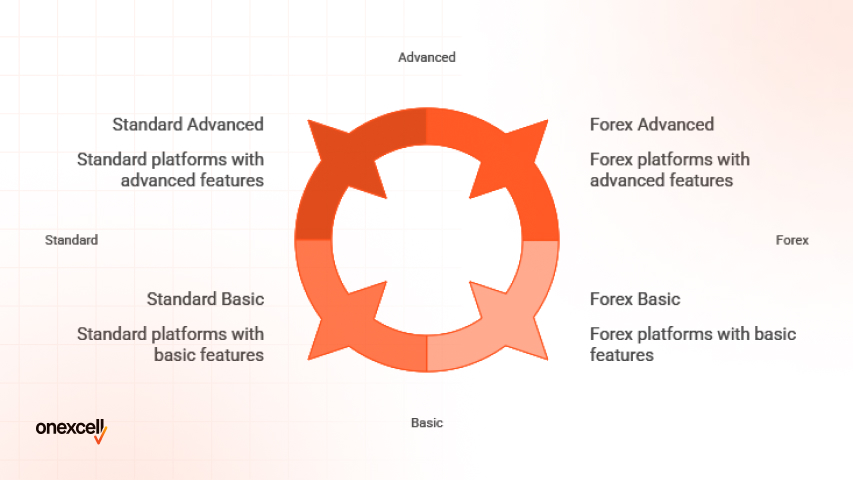
The things that make forex web development different from regular web development include the need for speed, real-time data handling, compliance, and security.
A normal website, such as an e-commerce shop or a blog, can work well with basic hosting, simple databases, and standard CMS platforms like WordPress or Shopify. But in forex, you are dealing with live trading environments, where milliseconds matter, and user trust is tied directly to how reliable your platform is.
For example, forex platforms must handle ultra-low latency trade execution, live price feeds from liquidity providers, and FIX/API integrations with brokers and payment systems. They also need account management dashboards, where traders can monitor balances, withdraw funds, or link to trading terminals like MT4/MT5.
On top of that, there are strict compliance rules such as KYC (Know Your Customer) and AML (Anti-Money Laundering) checks that must be built into the site.
The table below shows the difference between forex web development and regular web development:
| Aspect | Regular Web Development (e.g. blog/eCommerce) | Forex Web Development (trading platforms) |
| Speed & Latency | Page load within a few seconds | |
| Data Handling | Product details, static content | Live price feeds, real-time charting, APIs |
| Compliance | Basic GDPR, privacy policies | KYC/AML, financial regulations, global rules |
| Security Needs | SSL, firewalls, anti-spam | High-volume transaction security, DDoS protection |
| User Dashboard | Order tracking, account login | Full account management, deposits, withdrawals |
| Integrations | Payment gateways, plugins | FIX protocol, liquidity provider APIs, MT4/MT5 |
| Traffic Volume | Regular shopping or reading traffic | High-volume, 24/7 global trading traffic |
In short, a forex website is more like a live financial platform than a regular website, and choosing a developer who understands these unique web development needs is critical for your brokerage’s success.
Why Should You Define Your Brokerage Model Before Hiring a Forex Web Developer?
You should define your brokerage model before hiring a forex web developer because your business model shapes the entire platform design, integrations, and backend tools. In forex, there are three common models: ECN (Electronic Communication Network), STP (Straight Through Processing), and Market Maker.
If you plan to run an ECN brokerage, your platform must support direct liquidity routing, ultra-fast execution, and variable spreads. An STP model requires automated order processing with reliable liquidity provider APIs, while a Market Maker setup needs backend tools for managing spreads, risk, and dealing desk functions. Each model also influences what traders see in terms of pricing, execution speed, and account types.
That’s why it’s important to document your business goals and user expectations before hiring a developer. For example, if your audience values tight spreads and transparency, you may lean towards an ECN build.
If you want more control over pricing, you may choose a Market Maker model. In both cases, your web development partner should align the site architecture, APIs, and compliance tools with the specific brokerage structure you plan to run.
What Forex Website Features Should Your Developer Be Able To Build?
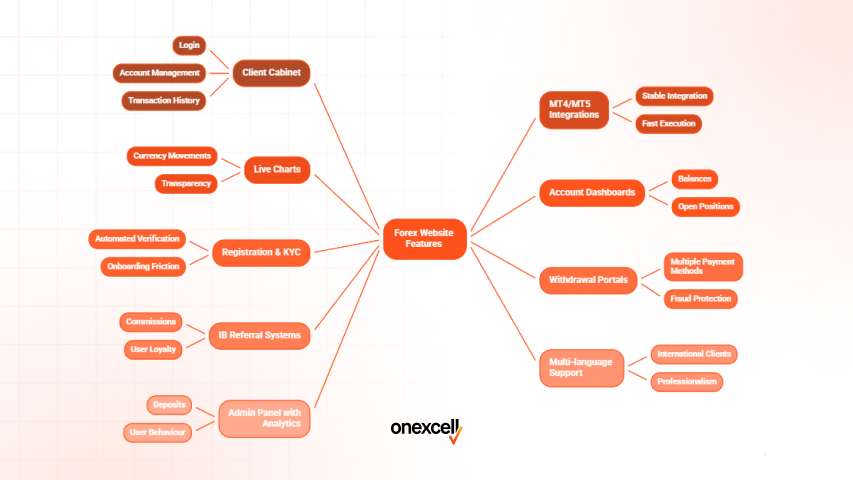
The forex website features that your developers should be able to build include real-time price feeds, secure client dashboards, account funding/withdrawal systems, and trading platform integrations like MT4/MT5.
They should also deliver KYC/AML compliance tools, risk management modules, and responsive mobile access to ensure traders can operate smoothly and safely. The forex website features that your developers should be able to build include both core must-haves and optional add-ons.
Here are the forex website features your developer should be able to build:
- Client Cabinet: This is the heart of your forex website where traders log in, manage their accounts, deposit or withdraw funds, and view transaction history. Without a secure and well-built client cabinet, user trust drops instantly.
- MT4/MT5 Integrations: Linking your website with trading terminals like MetaTrader 4 or 5 ensures traders can execute trades directly through your brokerage. This integration must be stable, fast, and error-free to avoid financial risks.
- Live Charts: Real-time price charts allow users to track currency movements without leaving your site. Charts also add credibility since traders expect transparency in pricing.
- Account Dashboards: Traders need dashboards showing balances, open positions, transaction history, and account status. This gives them control and improves user experience.
- Registration & KYC: Built-in registration forms with KYC (Know Your Customer) and identity verification are critical for compliance. Automated document upload and verification saves time and reduces onboarding friction.
- Withdrawal Portals: A smooth, secure withdrawal process builds trader confidence in your brokerage. Developers should integrate multiple payment methods, ensure speed, and protect against fraud.
- IB Referral Systems: Introducing Broker (IB) programmes allow users to earn commissions for referrals. Adding this can boost user acquisition and loyalty.
- Multi-language Support: Forex is global, so offering multiple languages helps you attract international clients. It also signals professionalism and inclusivity.
- Admin Panel with Analytics: A backend admin panel lets you track deposits, withdrawals, user behaviour, and overall performance. This helps you make data-driven business decisions.
What Technical Skills Should A Forex Web Dev Company Have?
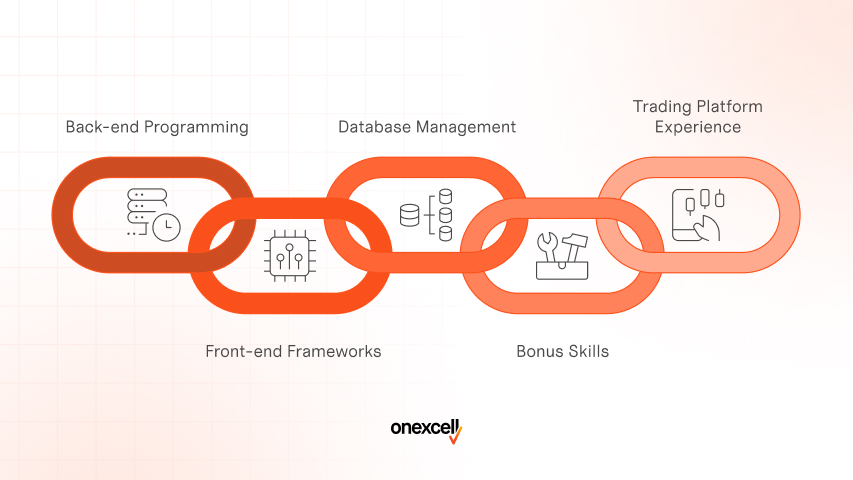
The technical skills a forex web development company should have include proficiency in trading APIs (FIX, WebSocket), strong backend programming (PHP, Node.js, Python), and database management for high-volume transactions. They should also master cybersecurity, encryption protocols, and cloud hosting to guarantee ultra-low latency and reliable platform performance.
The technical skills a forex web development company should have are explained below:
- Back-end (PHP, Node.js, Python): These languages are the backbone of forex platforms, powering trade execution, user authentication, and payment systems. A strong back-end ensures your site can handle heavy trading traffic securely and without delays.
- Front-end (React, Angular, or Vue): Modern front-end frameworks give traders a responsive, smooth, and intuitive interface. This matters because forex users expect real-time updates without lags or page reloads.
- Databases (MySQL, PostgreSQL, MongoDB): A forex site processes thousands of user transactions and price updates per second. Robust databases are essential for storing this data reliably while preventing bottlenecks.
- Bonus Skills (FIX API knowledge, trading engines, DevOps): Developers with FIX protocol expertise can integrate liquidity providers, while trading engine experience ensures your brokerage can handle fast order matching. DevOps skills are equally valuable for guaranteeing uptime and quick issue resolution.
- MT4/MT5 or Custom Trading Platform Experience: Ask whether the company has integrated MetaTrader or built custom trading systems. This experience shows they understand forex-specific workflows beyond general web projects.
How Do You Check If A Company Has Real Forex Industry Experience?
You check if a company has real forex industry experience by reviewing past projects, asking for case studies, and confirming client references in the trading sector. You can also check if they’ve worked with MT4/MT5 integrations, liquidity provider APIs, or compliance-ready platforms, which proves they understand real brokerage needs.
The tips to check if a company has real forex industry experience include:
- Request industry-specific portfolio samples: Ask to see websites or platforms they’ve built for forex brokerages. Real examples will show if they understand the complexity of trading environments.
- Ask for case studies with challenges and results: A serious agency should explain what problems they solved, such as latency or compliance, and how their solution improved the client’s business. This shows both expertise and accountability.
- Look for live, functioning Forex sites built by the agency: Test these sites yourself to check speed, security, and usability. A functioning project in the market is the strongest proof of their experience.
- Watch for red flags: Be cautious if the agency gives vague answers, refuses to name clients, or only shows static dashboards with no real functionality. These are signs that they may lack actual forex development experience.
What Questions Should You Ask A Forex Development Agency Before Hiring?

The questions you should ask a forex development agency before hiring include whether they have experience with MT4/MT5, FIX API, and compliance requirements like KYC/AML. You should also ask about their security practices, post-launch support, and how they handle high-volume trading environments.
Here’s what to ask and what to look out for:
- “Have you built a Forex website before?” Look for clear examples of live projects or client references. A vague or evasive answer is a red flag that they lack real industry experience.
- “What’s your approach to security and compliance?” They should mention KYC/AML checks, data encryption, and DDoS protection. If they give a generic answer like “we take security seriously” without specifics, it’s a warning sign.
- “Do you handle post-launch support and maintenance?” A reliable agency will have a support plan covering updates, bug fixes, and server monitoring. Overpromising “lifetime free support” is unrealistic and a red flag.
- “Can you integrate with liquidity providers or trading APIs?” The right answer includes experience with FIX API, MT4/MT5, or direct broker integrations. If they avoid naming protocols or platforms, they may not have hands-on expertise.
- “Can you scale the platform for multiple brokers/users?” Expect them to explain how they use cloud hosting, load balancing, and modular architecture. If they insist that scaling is “easy” without technical detail, be cautious.
Should You Choose A Custom Forex Platform Or A White-Label Solution?
You should choose between a custom forex platform or a white-label solution based on your business maturity and long-term goals.
A white-label platform is usually faster and cheaper to launch since the infrastructure is already built; you simply rebrand it and go live. This makes it attractive for new brokerages that want to enter the market quickly without heavy upfront investment. The downside, however, is limited flexibility: you cannot fully control features, customize the back-end, or easily add unique tools that set you apart from competitors.
A custom-built forex platform, on the other hand, is fully owned by you, giving complete control over design, functionality, and scalability. This option allows for deep integration with liquidity providers, unique features that support your brokerage model, and a tailored user experience that matches your brand.
The trade-off is that custom development takes more time to build and test, and costs significantly more upfront.
If you’re just starting and want to validate your business model, a white-label is the smarter entry point. But if you’re a serious brokerage aiming for long-term growth, scalability, and differentiation, investing in a custom platform will pay off by giving you full ownership and a competitive advantage.
What Is The Cost Of A Forex Web Development?

A forex web development costs anywhere from £10,000 to over £100,000, depending on whether you choose a white-label package or a fully custom-built solution. A white-label platform can start at around £10,000–£25,000, giving you a faster setup with limited customization.
Build a custom forex website, however, ranges from £40,000 to £100,000+, since it involves bespoke features like liquidity integrations, custom dashboards, and advanced compliance modules.
Agencies may charge using different models: fixed-price contracts (best if you have a clearly defined scope), hourly rates (flexible but harder to predict costs), or milestone-based contracts (where you pay in stages tied to project progress).
Beyond the initial build, don’t forget post-launch costs such as maintenance, cloud hosting, DevOps monitoring, upgrades, and compliance updates, which can run £1,000–£5,000 per month depending on scale.
To avoid surprises, it’s essential to set a clear scope and requirements before budgeting. This ensures you can balance upfront costs with long-term sustainability, choosing a pricing model that matches your business stage and growth goals.
What Red Flags Should You Watch Out For When Hiring A Forex Dev Team?
The red flags to watch out for when hiring a forex web dev team are vague answers about past projects, no proof of working forex platforms, and overpromising unrealistic timelines or costs. You should also be cautious if they lack knowledge of KYC/AML compliance, FIX APIs, or avoid discussing post-launch support.
Here’s a checklist of red flags you should watch out for when hiring a forex dev team:
- No real portfolio: If the agency cannot show live forex platforms or verifiable past work, it’s a major warning sign. Fake or irrelevant samples suggest they lack real industry experience.
- Fake testimonials: Be wary of generic reviews with no named clients or vague praise. Always cross-check testimonials with LinkedIn or direct references.
- Poor documentation: If they don’t provide clear project roadmaps, technical specs, or contracts, it shows a lack of professionalism and accountability.
- Unclear contracts: Contracts should spell out deliverables, timelines, costs, and support terms. Anything vague leaves you exposed to hidden costs or delays.
- Overpromising timelines: Claims like “we’ll build your platform in two weeks” are unrealistic and usually a sign of cutting corners.
- Ignoring compliance: If they don’t mention KYC, AML, or licensing requirements, they don’t understand the forex industry.
- Not asking about your brokerage model: A serious team will want to know if you’re running ECN, STP, or Market Maker, as this changes the platform’s structure.
Always practice due diligence: run background checks, ask for signed NDAs, and test previous work yourself before committing.
What Level Of Post-Launch Support Should You Expect?
The level of post-launch support you should expect is regular updates, active monitoring, bug fixes, and guaranteed uptime through a clear SLA (Service Level Agreement). A serious forex web development company should clarify what’s included in their package, from security patching and server hosting to platform scaling as your user base grows.
Since forex platforms run 24/7 across global markets, having a retainer or structured support plan in writing is essential to prevent downtime, protect transactions, and ensure a smooth trader experience long after launch.
Tips To Choose The Right Forex Web Development Company
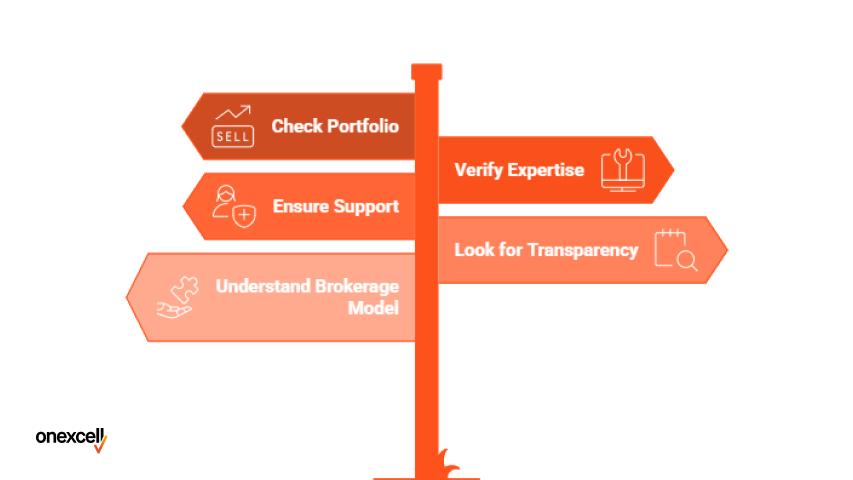
Tips to choose the right forex web development company are checking their proven forex portfolio, verifying technical expertise in APIs and compliance, and ensuring they offer strong post-launch support. You should also look for transparent contracts, realistic timelines, and a clear understanding of your brokerage model.
Here are tips to help you choose the right forex web development company:
- Check their proven forex portfolio: A good company should show you real, working forex platforms they’ve developed. This proves they can handle industry-specific challenges.
- Verify technical expertise: Look for skills in FIX API, MT4/MT5, compliance (KYC/AML), and secure database management. These are non-negotiable for trading environments.
- Ensure strong post-launch support: A reliable team will provide monitoring, bug fixes, and scaling options long after the website goes live.
- Look for transparent contracts and realistic timelines: Avoid developers who overpromise; clear contracts with milestones protect your investment.
- Check if they understand your brokerage model: Whether ECN, STP, or Market Maker, your chosen partner must adapt the platform to your specific business structure.
For brokerages looking to combine technical reliability with business-focused strategy, Onexcell is a strong choice. With experience in building scalable, secure, and compliant websites, Onexcell aligns its forex web design process with your brokerage goals, ensuring you launch with confidence.
How Long Does It Take To Build A Fully Functional Forex Website?
A fully functional forex website takes 3–6 months for a white-label solution and 6–12 months or more for a custom build. The timeline depends on features like liquidity integrations, compliance modules, and dashboards. Rushing the process often leads to bugs and compliance issues, so realistic planning is key.
Can I Migrate My Existing Trading Platform To A New Development Agency?
Yes, you can migrate your existing platform, but it requires careful handling of data, user accounts, and trading history. The new agency must ensure zero downtime, proper API reconfigurations, and compliance checks. Always test the migrated system thoroughly before going live.
What Legal Or Compliance Standards Should Forex Websites Follow Internationally?
Forex websites must follow KYC/AML rules, GDPR for data protection, and regional financial regulations. Depending on your jurisdiction, additional licensing may be required from regulators like FCA (UK) or CySEC (Cyprus). Ignoring compliance leads to fines, platform shutdowns, or loss of credibility.
Do I Need Separate Mobile And Desktop Versions Of My Forex Platform?
No, you don’t need separate versions if the site is built with responsive design and mobile-first frameworks. However, dedicated mobile apps can improve user experience and loyalty among active traders. Many brokerages invest in both responsive websites and apps to stay competitive.
What’s The Difference Between A Forex Crm System And The Trading Front End?
A forex CRM system manages client relationships, KYC, deposits, withdrawals, and back-office operations. The trading front end, on the other hand, is where users execute trades, view charts, and interact with the market in real-time. Both systems must be integrated seamlessly for a complete brokerage setup.