Forex lead generation is the process of attracting traders and converting them into funded accounts, measured not by leads but by cost per funded account and return on ad spend. The brokers who win do not chase the most leads. They chase the most profitable ones. That shift, from cost per lead to cost per funded trader, is the difference between a campaign that scales and one that quietly drains the budget.
Here is the hard truth most guides skip. Retail forex and CFD ads are restricted or banned on Google, Meta, and the app stores in many regions, so you cannot simply buy clients the way a normal e-commerce brand does. That single constraint reshapes the entire playbook. The smart move is to treat paid as a narrow, compliant, high-intent tool and to build your real scale on a wide channel stack: display, native, video, influencers, partners, and owned content.
This is the complete guide. It walks the acquisition funnel from click to funded trader, details every channel and the tools to run it, names the benchmarks, and gives 2 powerful, ready-to-use AI prompts for competitor analysis. Onexcell builds the brand, landing pages, and CRM-connected funnels behind this work at onexcell.co.uk, for brokers worldwide with a strong base across the Middle East.
What Does ROI-Driven Forex Lead Generation Actually Mean?
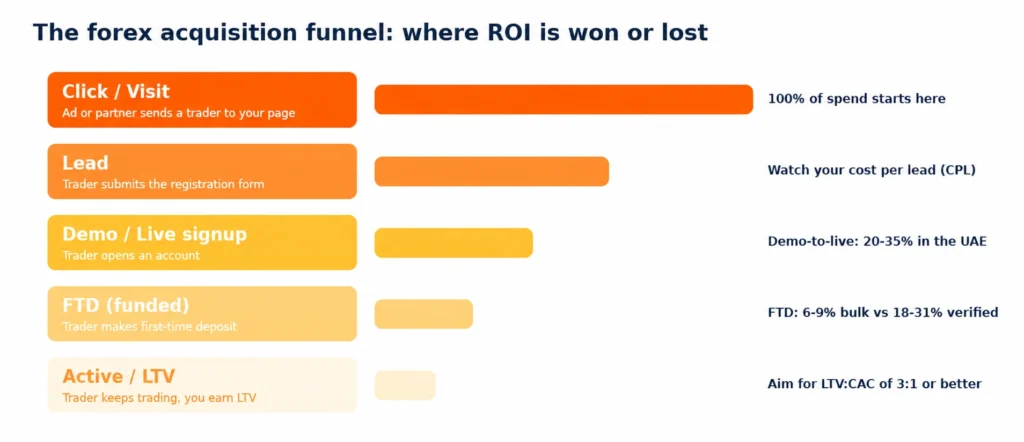
ROI-driven lead generation means optimising for funded traders and their lifetime value, not for the raw number of leads. A lead is only a promise. It pays nothing until that trader funds an account and trades. So the metrics that matter sit deeper in the funnel than most dashboards show.
There are 4 numbers that define forex lead-generation ROI:
- Cost per lead (CPL): what you pay for one registration. Useful, but never the goal.
- Cost per funded account (CPFTD): total spend divided by first-time depositors. This is the number that matters.
- Lifetime value (LTV): the net revenue a funded trader produces before they churn.
- LTV to CAC ratio: lifetime value against customer acquisition cost. Aim for 3 to 1 or better.
A campaign with a low CPL and a terrible CPFTD is a losing campaign that looks good on the surface. Always read the funnel to the bottom.
Pro tip. Track CPFTD per channel and per geo, not just blended. A blended number hides the truth. One source may deliver cheap leads that never deposit, while another delivers pricier leads that fund at triple the rate. You only see this when you split the data. Tools like Google Analytics 4, your Forex CRM reporting, and a tracker such as Voluum or a partner platform make this split visible.
Why Must You Confirm Regulation Before You Advertise?
Confirm you hold the licences and regulatory approvals before you copy any top broker’s campaigns. It is tempting to look at a market leader, see their ads and offers, and copy them. That is a fast route to disaster if you do not hold the same regulatory standing. Forex ad platforms check licensing, and running ads without the right regulation can get your ad account restricted, sometimes permanently.
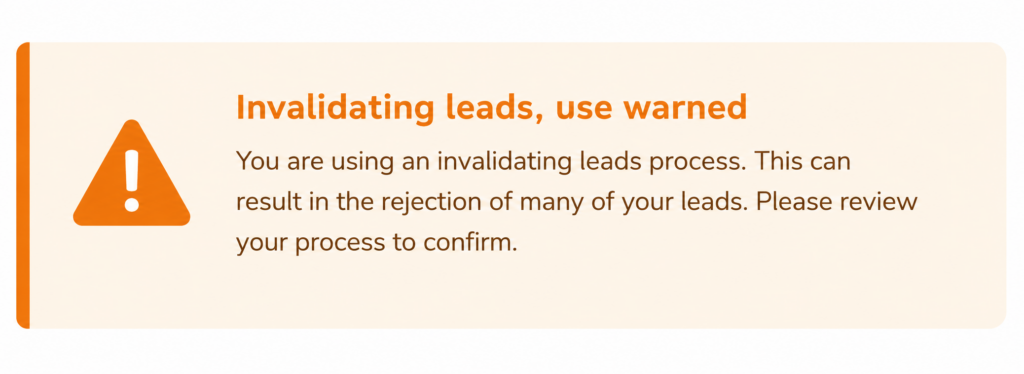
There are 4 checks to run before any paid campaign goes live:
- Confirm the regulated entity and licence that will appear on your ads and landing pages.
- Complete the ad platform’s financial-services advertiser verification for each target region.
- Check that forex and CFD ads are permitted at all in your target country, since many ban them.
- Match your offers to what your licence allows, not to what a bigger, differently regulated broker runs.
A top broker may advertise leverage, bonuses, or claims that their licence permits and yours does not. Copy them blindly and you risk both your ad account and your brokerage licence. Build your campaigns around your own regulatory reality first.
Must read this blog: How to Avoid Ad Rejection on Meta for Forex Ads?
Why Is Forex Paid Marketing So Different?
Forex paid marketing is restricted, expensive, and compliance-bound, so it cannot be your only growth engine. Google Ads classifies CFDs and rolling spot forex as restricted financial products. In many countries they are banned outright, and where allowed, the advertiser must be certified, carry risk warnings, and meet local promotion rules. Meta applies similar limits, and the app stores gate trading apps. The channels a normal startup leans on first are largely closed to you.
This is why cost per lead in forex runs far higher than in most sectors. The winning response is not to fight the restriction. It is to design around it with a wide, diversified channel stack, so no single ad-policy change can stop your growth.
Which Channels Generate Forex Leads, and How Do You Run Each?
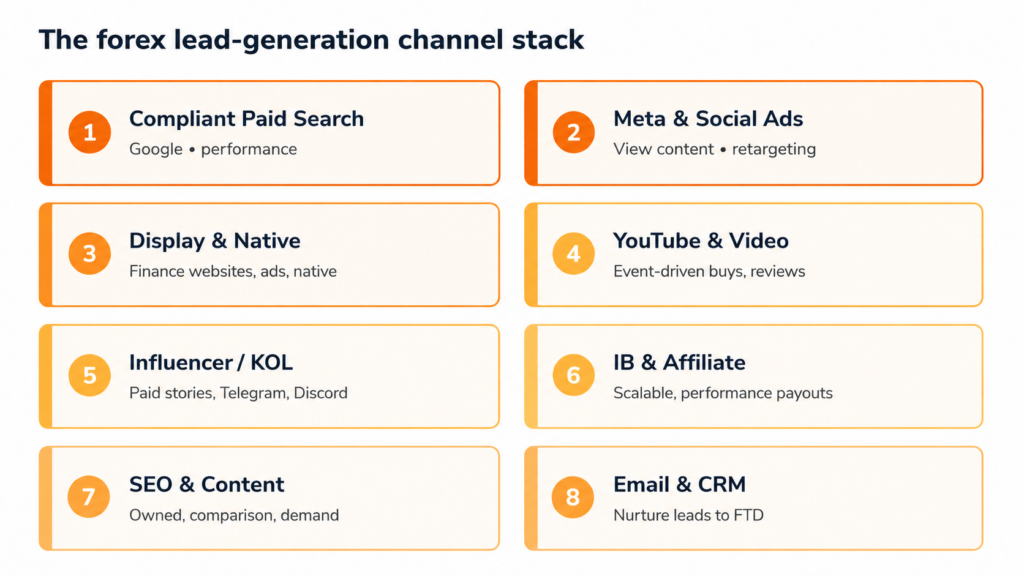
There is no single channel. The strongest brokers run a stack of 8: compliant paid search, Meta and social, display and native, video, influencer and KOL, IB and affiliate, SEO and content, and email. Each channel has a different job, cost, and risk. Run them as a portfolio, and measure every one on cost per funded account.
Must read this blog: How to Build a Forex Broker Website From Scratch?
1. Compliant Paid Search
Paid search captures traders already looking for a broker. Where forex ads are permitted, spend on branded terms, platform queries like MT4, MT5, and cTrader, and high-intent comparison keywords. Use location targeting for compliance and accuracy, and send every click to a dedicated landing page. Tools: Google Ads with financial-services certification, Microsoft Ads, and Google Keyword Planner or Semrush for research.
2. Meta and Social Ads
Meta restricts financial products, but where permitted it is strong for retargeting and warm audiences. Meta also runs its own programs and tools for financial advertisers, so check current eligibility and certification before spending. Use it for remarketing to site visitors and lookalike audiences from your funded-trader list, not cold prospecting. Tools: Meta Ads Manager, the Meta Pixel, and Conversions API for accurate tracking.
3. Display and Native Ads
Display and native ads reach traders across finance and news sites, and forex-specific ad networks open inventory the big platforms restrict. Formats include native, banner display, push, in-page push, and pop. Networks such as RichAds and Blockchain Ads specialise in trading traffic across many geos and offer compliance-aware targeting. Use native for education-led angles and display for retargeting. Tools: Google Display Network, plus forex ad networks for restricted geos.
4. YouTube and Video
Video is the due-diligence layer of the funnel. Many traders will not register until they have watched a review or walkthrough of your platform. They search your brand name, and whatever ranks becomes your reputation. Publish honest platform demos, market analysis, and education, and where permitted run skippable in-stream ads to warm audiences. Tools: YouTube, YouTube Ads, and a simple editing stack for consistent, branded video.
5. Influencer and KOL Marketing
Finfluencers and KOLs reach trusted, pre-qualified trader audiences that ads cannot. Around 70% of consumers trust influencers and peers over brands directly, and in trading much of the real conversation now lives in private Telegram and Discord communities, sometimes called dark social. Micro-KOLs with engaged trading audiences often beat big names on cost per funded account.
There are 4 rules for running forex influencer and KOL campaigns:
- Vet for a real, active trader audience, not vanity follower counts.
- Map adjacent niches too: macroeconomics, fintech, and algo trading attract high-intent users.
- Require compliant disclosures and risk warnings in every piece of creator content.
- Track funded accounts, not likes, by giving each creator a unique link or code.
A common budget split is the 60/25/15 rule: 60% to creator fees, 25% to amplifying the best content with paid boosting, and 15% to management and tracking. Tools: a partner or affiliate platform for unique links, plus Telegram and Discord for dark-social KOLs.
Must read this blog: Generating Forex Leads: A Quick Guide in 5 Easy Steps
6. IB and Affiliate Partners
IBs and affiliates are the scalable engine, because their capacity grows with the number of partners, not your ad budget, and they are paid from revenue. Industry estimates put this channel at 35% to 60% of new retail account acquisition for large brokers. An affiliate sends traffic and is usually paid once on CPA when a referral funds. An IB keeps a relationship with the trader, does in-person outreach and education, and earns recurring rebates on activity, which is especially powerful in the Middle East and Asia. Tools: a commission and attribution platform such as Track360, Cellxpert, or your Forex CRM’s IB module.
Pro tip. Typical forex CPA runs between $200 and $800 per funded account, depending on jurisdiction and minimum deposit. Model this against trader LTV before you agree a rate. A high CPA is fine if the traders fund well and stay active; a low CPA on weak traders is a false economy.
7. SEO and Content
SEO is the channel rivals cannot buy their way into, because paid is restricted. Educational guides, platform explainers, and comparison pages rank over 6 to 12 months and feed every other channel: your partners link to them, your ads point at them, and AI engines cite them. Treat content as infrastructure, not a campaign. Tools: Google Search Console, Semrush or Ahrefs, and Google Analytics 4.
8. Email and CRM Nurture
Email turns leads into funded accounts and funded accounts into active traders. Build the list with lead magnets like market reports, webinars, and instant demo accounts, then segment by experience, behaviour, and geo. Personalised sequences move a cautious lead toward a first deposit. Tools: your Forex CRM, plus an email platform, and an AI support assistant to handle onboarding chats at scale.
Build a lead engine that converts, with Onexcell
Onexcell is a UK web design and development agency that builds forex broker and prop firm websites, premium brand identities, high-converting landing pages, and Forex CRM-connected registration funnels. The team works with brokers worldwide, with deep experience across the Middle East in the UAE, Qatar, Oman, and Kuwait, where trust and brand quality decide ROI.
Want a higher-converting funnel and a premium brand for your brokerage? Use the form at onexcell.co.uk to send your question. The team replies within one business day.
How Do You Judge Forex Lead Quality?
Judge lead quality by how many leads fund an account, not by how many you collected. Lead quality is the single biggest lever on ROI, and it varies enormously by source and geo. Recent 2026 data shows brokers using verified, geo-targeted leads convert 18% to 31% of contacts into funded accounts, against an industry average of 6% to 9% for unverified bulk lists. That is a 3x to 4x difference from quality alone.
There are 4 questions to ask any lead source or CPA partner before you spend:
- What share of leads open a demo account within 48 hours? A healthy ratio is 30% to 50%.
- What is the demo-to-live conversion? Top sources in the UAE hit 20% to 35%.
- What is the cost per funded account, not just the cost per lead?
- Is every lead consented and compliant for your target region?
The Middle East rewards quality especially well. The UAE is the highest-value market per lead in the region, where traders expect premium service, multi-language support, and visible regulation. Cheap, unverified lists perform worst exactly where the upside is highest.
How Do You Convert Forex Leads Into Funded Traders?
Convert leads by removing friction at every step from the landing page to the first deposit. Most ROI is lost after the click, not before it. A strong source feeding a weak funnel still fails.
What Makes a Forex Landing Page Convert?
A forex landing page converts when it matches one audience, makes one promise, and asks for one action. Send paid and partner traffic to dedicated landing pages, never to a generic homepage. There are 5 elements every high-converting forex landing page needs:
- A benefit-led headline that speaks to the exact audience the ad targeted.
- A short registration form, since every extra field loses leads.
- Visible trust signals: the regulated entity, the platform, and real proof.
- The required risk warning, placed for compliance, which also builds trust.
- One clear call to action, usually to open a demo or live account.
How Does the Registration and CRM Flow Affect ROI?
The registration flow is where leads convert or vanish, so it must be short, fast, and connected to your Forex CRM. The website forms for live and demo accounts feed the CRM, which starts onboarding and KYC. Offer an instant demo account the moment a trader gives an email, since trying the platform is the strongest signal of intent.
Pro tip: Prioritise mobile end to end. Many traders find you, register, verify, and fund entirely on a phone, especially younger traders and Gulf markets. A registration flow that breaks on mobile quietly destroys your ROI no matter how good the ad was.
Why Does Branding Decide Whether You Win Premium Clients?
Your brand and creative quality decide whether you attract premium traders or cheap, low-value ones. Marketing brings the click, but the brand decides who clicks and who trusts you enough to fund. In a trust business like forex, a clean, premium, consistent brand is not decoration. It is a filter that pulls in the clients you actually want.
Cheap, flashy, cluttered graphics signal a cheap, risky broker, and they attract bargain-hunting, high-churn traders. Clean, calm, high-quality design signals a serious, regulated brokerage, and it attracts the premium, higher-deposit clients who stay. Your creative direction is a decision about which type of client you want.
Pro tip. Make your broker branding high quality and consistent across every platform, from the website to ads to social to partner materials. Keep graphics clean and trustworthy, not flashy or cheap. Premium, restrained design pulls in premium clients; cheap, loud design pulls in cheap ones. Your creative direction decides which clients you attract, so choose it deliberately.
Pro tip. Do not focus only on marketing and lead generation. Build the brand too. Lead generation fills the funnel today, but brand building lowers the cost of every future lead, raises conversion, and earns the trust that turns one-time depositors into long-term traders. Fund both, not just the campaigns that show results this month.
How Do You Use Competitor Analysis to Sharpen Lead Generation?
Study how rival brokers acquire and convert, then beat them on the weakest part of their funnel. Competitor analysis tells you which offers, audiences, channels, and angles already work in your market, so you spend less learning the hard way. The 2 prompts below are deep, structured templates for AI tools like ChatGPT, Claude, or Perplexity. Fill in the bracketed details, run them, and treat the output as expert research you then verify, not a finished plan.
Must read this blog: 12 Proven Ways to Drive Organic Traffic to Your Website
Prompt 1: Full Competitor Funnel and Channel Teardown
This prompt reverse-engineers a competitor’s entire acquisition funnel, channel by channel, and surfaces the specific gaps you can exploit.
AI PROMPT: Competitor funnel and channel teardown
you are a senior forex performance marketing strategist with
15 years of experience acquiring funded traders in regulated
and offshore markets. Analyse my competitor in depth.
CONTEXT
- - My brokerage: [YOUR BROKER NAME]
- - My regulation/licence: [LICENCE, e.g. offshore + ME office]
- - My target market: [COUNTRY/REGION, e.g. UAE, Qatar]
- - My target trader: [BEGINNER / EXPERIENCED / HNW]
- - My main strengths: [SPREADS / PLATFORM / SUPPORT / SPEED]
- - Competitor to analyse: [COMPETITOR NAME / WEBSITE URL]
DELIVER A STRUCTURED ANALYSIS
1. Positioning: how they describe themselves, their core
promise, and the trader segment they target.
2. Channel mix: assess each channel (paid search, Meta/social,
display/native, YouTube/video, influencer/KOL, IB/affiliate,
SEO/content, email) and rate how strongly they use it
(high/medium/low/none) with the evidence you would check.
3. Offer and hook: their main acquisition offer (demo, bonus
where legal, education, raw spreads, contests) and how it
compares to mine.
4. Landing page and funnel: likely strengths and friction
points from click to registration to first deposit.
5. Brand and creative: is their design premium or cheap, and
what type of client does that attract?
6. Content and SEO: the topics and keywords they likely rank
for, and the content gaps they leave open.
7. Compliance posture: where their messaging may breach ad
rules in [COUNTRY/REGION] (note, do not copy these).
THEN OUTPUT
- - A table scoring them 1-5 on each channel and on brand.
- - The 5 biggest weaknesses in their funnel.
- - 5 specific, prioritised actions I can take to win higher-
quality leads at a lower cost per funded account.
- - 3 things they do well that I should not ignore.
Be concrete. Avoid generic advice. If you are unsure, say so
and tell me how to verify it.
Prompt 2: Counter-Offer, Angle, and Creative Brief Generator
Once you understand a competitor, this prompt turns that insight into sharper offers, ad angles, and a creative brief your designer or agency can act on.
AI PROMPT Counter-offer, angle, and creative brief
You are a senior forex copywriter and conversion strategist.
Using the competitor analysis below, design a campaign that
wins higher-quality, premium traders for my brokerage.
INPUTS
- My broker: [YOUR BROKER NAME]
- Target audience: [AUDIENCE] in [COUNTRY/REGION]
- Language(s): [e.g. Arabic and English]
- My strengths: [SPREADS / PLATFORM / SUPPORT / REGULATION]
- Competitor offer and weakness: [PASTE FROM PROMPT 1]
- Brand feel I want: premium, clean, trustworthy, not flashy.
DELIVER
- Five landing page headline options that beat their hook
and name my audience's real problem (no hype, no
guaranteed-return language).
- Three differentiated offers/angles to A/B test, each with:
- the exact trader segment it suits,
- the single call to action,
- the proof element that raises trust.
- A short creative brief for each angle: tone, colour mood,
imagery style, and what to avoid, so the design stays
premium and attracts higher-deposit clients.
- Three reasons a trader might not convert, and the exact
funnel fix for each.
- A 30-day test plan: which channels to run each angle on,
the metric to judge it by (cost per funded account), and
the kill or scale rule.
Keep every claim compliant for [COUNTRY/REGION]. Write the
headlines in [LANGUAGE]. Be specific and ready to use.
Pro tip. Run Prompt 1 on your top 2 or 3 competitors, then feed each result into Prompt 2. Look for the pattern across rivals. If every competitor ignores Arabic-language education, or every registration form is long and clunky, or every brand looks cheap, that shared gap is your cheapest route to better, premium leads.
What Forex Lead-Generation Mistakes Destroy ROI?
The biggest ROI killer is optimising for cheap leads instead of funded traders. There are 8 mistakes that drain forex lead-generation budgets, listed below.
| Mistake | Why it destroys ROI |
| Copying brokers you cannot legally match | Their licence allows offers yours may not; ads get restricted or banned. |
| Chasing cost per lead | Cheap leads that never fund cost more than expensive ones that do. |
| Buying unverified bulk lists | Bulk lists fund at 6-9% versus 18-31% for verified, geo-targeted leads. |
| Relying on one channel | An ad-policy change can zero a single channel overnight. |
| Cheap, flashy branding | Low-quality creative attracts low-value, high-churn traders. |
| Sending traffic to the homepage | Generic pages waste paid and partner traffic that needs a landing page. |
| Treating IBs like affiliates | Different funnels and payouts; lumping them together loses the IB channel. |
| No per-channel measurement | Blended metrics hide which sources fund and which only signup. |
Frequently Asked Questions About Forex Lead Generation
1. What Is a Good Cost Per Funded Account in Forex?
A good cost per funded account in forex usually sits between $200 and $800 through IB and affiliate CPA, depending on jurisdiction and minimum deposit. The right number is whatever keeps your LTV to CAC ratio at 3 to 1 or better. Judge any CPA against trader lifetime value, not against a fixed target.
2. Can Forex Brokers Advertise on Google and Facebook?
Sometimes, but only under strict limits, and only with the right licence. Google and Meta classify CFDs and forex as restricted financial products, banned in many regions and gated elsewhere behind certification and risk-warning rules. Running ads without proper regulation can get your account restricted, sometimes permanently.
3. What Are the Best Channels for Forex Lead Generation?
The best results come from a stack, not one channel: compliant paid search, Meta and social, display and native, YouTube and video, influencer and KOL, IB and affiliate, SEO and content, and email. IB and affiliate usually scales best, while content lowers cost over time. Run them as a portfolio and measure each on funded accounts.
4. Does Influencer Marketing Work for Forex Brokers?
Yes, when done compliantly. Finfluencers and KOLs reach trusted, pre-qualified trader audiences, and much of that audience now lives in private Telegram and Discord groups. Vet for a real trading audience, require risk-warning disclosures, and track funded accounts through unique links. Micro-KOLs often beat big names on cost per funded account.
5. How Important Is Branding in Forex Lead Generation?
Branding decides which clients you attract. Premium, clean, consistent design pulls in higher-deposit, longer-staying traders, while cheap, flashy graphics attract low-value, high-churn ones. Brand building also lowers the cost of every future lead, so fund it alongside lead generation, not instead of it.
6. Should Forex Brokers Buy Forex Leads?
Brokers can buy forex leads, but only verified, consented, and geo-targeted ones, and always measured by funded accounts. Unverified bulk lists waste budget and create compliance risk. Treat bought leads as one input in a wider mix, and track their cost per funded account against your own channels.
Final Word: Optimize for Funded Traders, Not Leads
Forex lead generation rewards the marketer who reads the funnel to the bottom. Confirm your regulation first, build around the ad restrictions, and run a full channel stack instead of betting on one. Use compliant paid for high intent, display and native for reach, video and KOLs for trust, partners for scale, and content for durable demand. Wrap it all in a premium brand, and judge every channel on cost per funded account and lifetime value.
Here is the ROI-driven approach in 8 steps:
- Confirm your license and regulation before copying any competitor’s ads.
- Define success as cost per funded account and LTV to CAC, not cost per lead.
- Run a full channel stack and measure each one separately.
- Use verified, consented, geo-targeted leads only.
- Build IB and affiliate partners as your scalable engine.
- Invest in a premium, consistent brand to attract premium clients.
- Send every campaign to a dedicated, fast, single-action landing page.
- Run competitor analysis, then beat rivals on their weakest funnel step.
Do this, and lead generation stops being a cost centre that swallows budget and becomes a measurable engine that turns spend into funded, active, loyal traders.