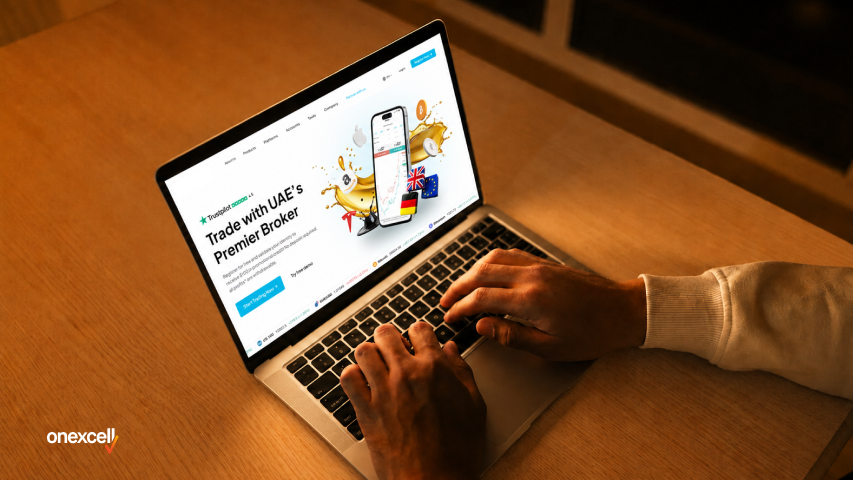
A forex broker website is the conversion engine of a brokerage, a 24/7 platform that turns search traffic and ad clicks into registered, funded traders. Building one from scratch follows 7 practical steps: market and content planning, domain and hosting, technology choice, UI/UX design, third-party integrations, landing pages, and Forex SEO. A 2023 Deloitte Digital report found that 53% of mobile users leave a site that takes longer than 3 seconds to load, so speed is a commercial decision for any forex broker website, not a technical detail.
Most brokers spend months on spreads, leverage, and liquidity, then 2 weeks on the website. That order is wrong. The website is the first asset a trader judges, before a single trading condition is read. Onexcell builds forex broker websites at onexcell.co.uk for brokers worldwide, with a strong base in the Middle East across the UAE, Qatar, Oman, and Kuwait. The 7-step process below is the same one the team applies to every broker build.
This guide gives more than definitions. It names the tools, the hosting providers, and the design choices that convert, so a broker reading it finishes with an action plan and no open questions.
What Should You Decide Before Building a Forex Broker Website?
Decide your business model, your regulatory setup, and your target market before any website work begins. These 3 decisions are business decisions, not website-build steps, yet they shape every page. The business model sets the account types and pricing shown on the site. The regulatory setup decides which disclosures and risk warnings appear. The target market controls language, payment methods, and content tone.
Many brokers hold an offshore licence, such as a Mauritius or Seychelles registration, while running a representative office in Dubai or another Gulf city. The website states the regulated entity and licence clearly, wherever that licence sits. Confirm the regulated entity, the licence, and the required risk warnings before writing content, because retrofitting compliant copy after launch wastes time.
How Do You Define Your Target Market?
Define your target market by answering 4 questions before design starts. The answers control tone, structure, and content across the whole forex broker website.
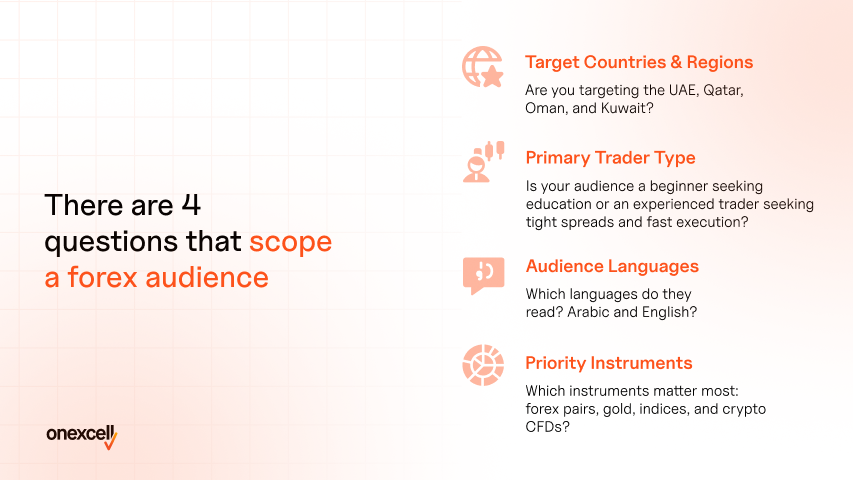
There are 4 questions that scope a forex audience:
- Identify the countries and regions being targeted, such as the UAE, Qatar, Oman, and Kuwait.
- Identify the primary trader: a beginner seeking education or an experienced trader seeking tight spreads and fast execution.
- Identify the languages the audience reads, such as Arabic and English.
- Identify the priority instruments, such as forex pairs, gold, indices, and crypto CFDs.
Write the content around the country you target. A site aimed at Gulf traders reads differently from one aimed at European traders in tone, examples, and layout. Most broker sites also carry wrong numbers in their copy, such as spreads and leverage figures, so verify every value before publishing.
Pro tip: If you plan to target several countries, set up subdomains or subdirectories for each market from day one. You can add as many country versions as you need, and each one reaches its own audience with local language and local examples.
How Do You Choose a Domain and Hosting for a Forex Broker Website?
Choose a short, brand-matched domain and a fast, secure hosting provider. The domain is a trust signal that a trader reads before the site loads. The hosting controls speed, uptime, and security, which feed directly into rankings and conversions.
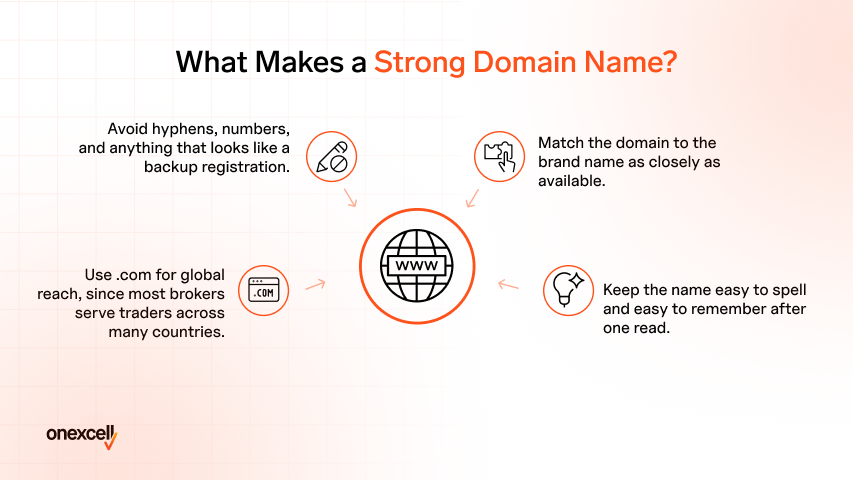
What Makes a Strong Domain Name?
A strong domain name is short, professional, and matched to the brand. There are 4 rules that produce one:
- Avoid hyphens, numbers, and anything that looks like a backup registration.
- Use .com for global reach, since most brokers serve traders across many countries.
- Match the domain to the brand name as closely as available.
- Keep the name easy to spell and easy to remember after one read.
Which Hosting Providers Work Best for Brokers?
Managed cloud hosting works best for a forex broker website, because it delivers fast load times, strong security, and room to scale. There are 4 hosting providers that perform well for brokers, listed below with their main strength.
| Hosting provider | Main strength for a broker website |
 Cloudways Cloudways | Managed cloud hosting with choice of server location and easy scaling. |
 Kinsta Kinsta | Premium managed WordPress hosting with strong speed and security. |
 SiteGround SiteGround | Reliable performance with built-in caching and good support. |
 AWS or DigitalOcean AWS or DigitalOcean | Full control and global server regions for custom builds. |
Enable SSL, add DDoS protection, and use a content delivery network (CDN) such as Cloudflare to serve static files quickly to every region. Place the server close to your main audience to cut latency for Gulf traders.
Pro tip. Avoid the cheapest shared plan. A slow forex broker website loses more in conversions than a managed host costs each month. Start on managed cloud hosting and scale as traffic grows.
Which Technology Should You Use for a Forex Broker Website?
Use WordPress, a PHP framework, or React, since all 3 build a fast, professional forex broker website. The website is a promotional tool, not a trading platform. It stores no client funds and runs no trades, so the technology matters less than the result. No broker integrates MT4 or MT5 into the website itself. The trading platforms sit on their own infrastructure, and the website only links traders to them.
There are 3 technology options used for forex web development, compared below by strength and best-fit broker.
| Technology | Strength | Best for |
 WordPress WordPress | Fast launch and easy content editing with no code. | Most brokers and prop firms. |
 PHP framework (Laravel) PHP framework (Laravel) | Balanced control and speed with custom logic. | Forex brokers want custom features. |
 React or Next.js React or Next.js | Highest performance and fully custom UI. | Brokers with an in-house dev team. |
The technology debate is less important than most teams think. What matters is that the website loads fast, looks premium, and updates easily. Whatever you choose, target a load time under 2 seconds on mobile, and test with Google PageSpeed Insights and GTmetrix before launch and after every major update.
How Should You Design the UI and UX of a Forex Broker Website?
Design the UI to build instant trust and the UX to guide every visitor toward one clear action. A forex broker website should not just look good. It should solve the trader’s problem with clear headlines, detailed subheadings, fast speed, and clean navigation. Many broker sites fail the moment a trader tries to use them, even when they look polished.
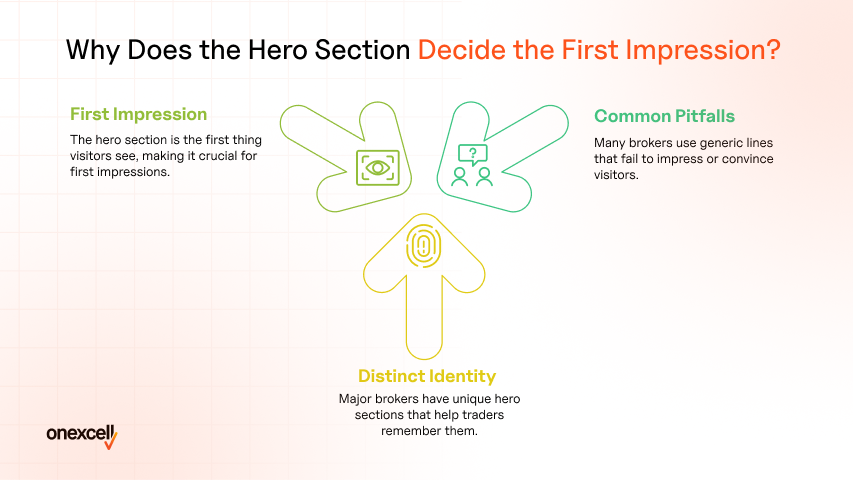
Why Does the Hero Section Decide the First Impression?
The hero section decides the first impression, because it is the first thing every visitor sees. Most brokers waste it with a common line such as ‘Trade with us, trade with confidence’, which says nothing and convinces no one. Every major broker has a distinct hero section with its own identity, which is how traders remember them.
There are 3 jobs a strong hero section performs:
- State clearly what the broker offers and who it serves.
- Give one specific reason a trader should choose this broker.
- Lead to one action, such as opening a demo account or viewing account types.
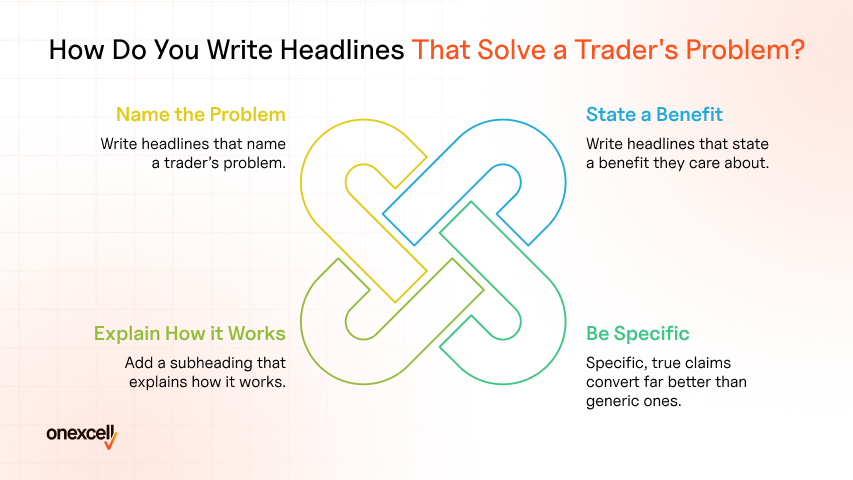
How Do You Write Headlines That Solve a Trader’s Problem?
Write headlines that name a trader’s problem or state a benefit they care about, then add a subheading that explains how it works. A headline that fits any broker fails. Specific, true claims convert far better than generic ones.
There are 2 contrasts that show the difference:
- Weak: ‘Advanced Trading Technology’. Stronger: ‘MT5 with raw spreads from 0.0 pips and no dealing desk’.
- Weak: ‘Dedicated Support’. Stronger: ’24/5 support in Arabic and English’.
Which Design Principles Improve Conversion?
Mobile-first design improves conversion most, because most forex traffic is mobile. A 2023 Statista study reported that 58.7% of global web traffic came from mobile devices. There are 7 design principles that convert trading traffic:
- Build mobile-first layouts, since most forex visitors browse on phones.
- Keep clean navigation, so a trader finds account types and platforms in one click.
- Add 2 or 3 high-impact ‘wow’ sections in the middle of long pages to re-engage readers.
- Use a trust-led palette of deep blues, clean whites, and controlled accent colours.
- Place one primary call to action above the fold on every key page.
- Explain each account type clearly, showing spreads, commission, minimum deposit, and leverage.
- Interlink pages logically, so platforms sit one click from account types.
Pro tip. Do not copy large brokers blindly. Many sections on big broker sites exist for historical or regional reasons that may not apply to a newer brokerage. Follow the best brokers, but understand why each section exists before you add it. If you cannot explain why a section is there, leave it out.
Finish the design structure first, then write the content to fit it. Writing copy for a layout that does not exist yet produces text that does not fit the design. Once the UI is set, write the content around the agreed structure, in the language and style of the target country.
Build a forex broker website with Onexcell
Need to ask something else? Use the form at onexcell.co.uk/contact to send your question. The team replies within one business day.
Onexcell is a UK web design and development agency that builds forex broker websites for brokers worldwide, with a strong client base across the Middle East in the UAE, Qatar, Oman, and Kuwait. The team designs fast, premium, high-converting websites built around your traders.
Which Tools and APIs Should a Forex Broker Website Integrate?
Integrate APIs for registration forms, live rates, an economic calendar, and other third-party tools such as copy trading, Trading Central, and calculators. No broker integrates MT4 or MT5 into the website. The website connects to third-party tools that improve the trader experience and drive conversions. There are 5 integrations that matter most.
How Does the Registration Integration Work?
The registration integration connects the website forms to the broker’s CRM or client portal. CRM integration on the website covers registration only: the live account form and the demo account form. A trader fills the form on the site, and the CRM receives the lead and starts onboarding.
A registration integration includes 3 parts:
- Connect the live account opening form to the CRM.
- Connect the demo account opening form with instant access.
- Keep the form short and smooth across mobile, since long forms lose leads.
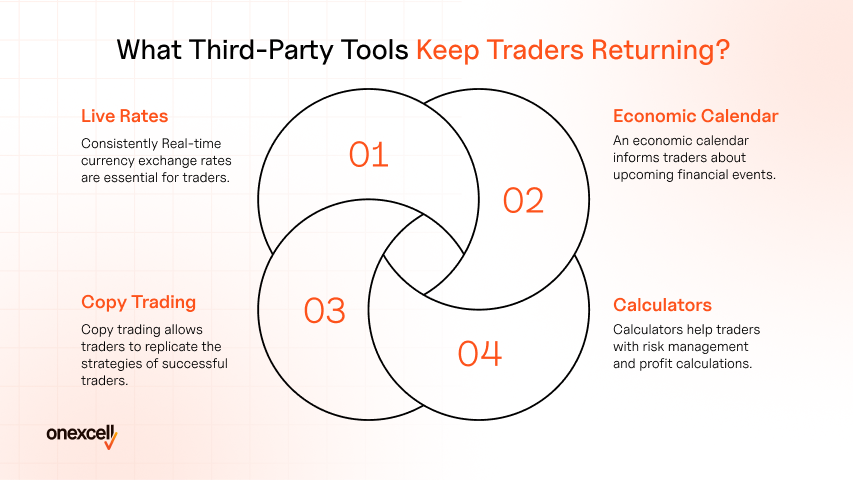
What Third-Party Tools Keep Traders Returning?
Live rates, an economic calendar, copy trading, and calculators keep traders returning to a forex broker website. These tools raise time on site and strengthen Forex SEO signals. There are 4 third-party integrations to prioritise:
- Live rates and price feeds: show major pairs, indices, and commodities through providers such as Morningstar, Refinitiv, or a liquidity-provider API.
- Economic calendar: add a calendar from Trading Central or Trading Economics, filtered by impact and currency.
- Trading tools and calculators: add pip, margin, and profit-and-loss calculators as lightweight tools.
- Copy and social trading: add PAMM or copy-trading widgets that show master-trader performance in a compliant format.
Embed each tool as a lightweight widget so page speed holds. Add a live chat tool such as Intercom, Tidio, or Zendesk, connected to the support team during core trading hours, since a fast pre-registration answer is one of the highest-converting actions a broker can take.
How Do You Build Forex Landing Pages That Convert?
Build each forex landing page around one audience, one message, and one action. The homepage is not the only entry point. Traders arrive through paid search, organic results, partner referrals, and social media, and each channel deserves a dedicated landing page built for that intent.
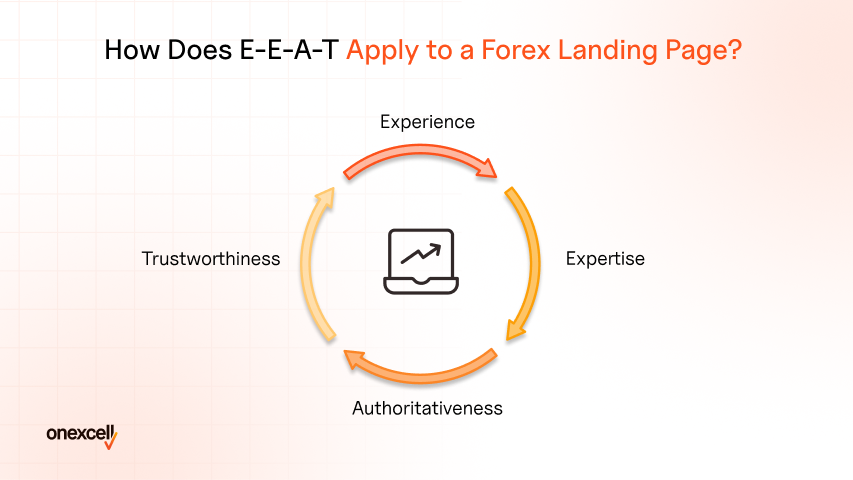
How Does E-E-A-T Apply to a Forex Landing Page?
Google’s E-E-A-T framework applies to a forex landing page by structuring proof of Experience, Expertise, Authoritativeness, and Trustworthiness. Follow it as closely as possible on every high-conversion page. There are 4 ways to demonstrate it:
- Experience: show testimonials, trade data, and community proof where compliant.
- Expertise: use accurate spreads, clear account details, and informed content.
- Authoritativeness: display the regulated entity, awards, and media mentions.
- Trustworthiness: show company details, address, risk warnings, and fund-protection information.
What Does Every Forex Landing Page Need?
Every forex landing page needs 6 elements to convert paid and organic traffic:
- Write a benefit-focused headline that speaks to the page’s specific audience.
- Repeat one clear call to action at logical points down the page.
- Place the regulated entity and risk disclaimer per compliance rules.
- Add social proof through awards, trader counts, reviews, or partner logos.
- Use a short form that captures the lead without extra steps.
- Remove navigation links that pull visitors off the conversion path.
Pro tip. Build landing pages for your highest-value paid campaigns before launch. Sending paid traffic to a homepage is one of the most expensive mistakes in forex lead generation.
How Do You Approach Forex SEO From Day One?
Plan Forex SEO from day one of the website planning, because rankings take 3 to 6 months to build. A site that adds SEO after launch starts months behind. SEO is infrastructure for a forex broker website, not a marketing add-on. Make sure every section the site needs is live from the first day of launch, with no placeholder or thin pages.
How Should Site Structure Map to Keywords?
Map each page to one target query, so the site structure mirrors how traders search. Start with 6 core pages: account types, trading platforms, instruments, spreads and commissions, regulation, and deposits and withdrawals. Build supporting content around related queries from there. Keep every page free of fluff, since thin content does not rank and does not convert.
Which Technical SEO Foundations Matter Most?
There are 7 technical Forex SEO foundations to set before launch:
- Use one H1 per page with a logical H2 and H3 hierarchy below it.
- Write unique meta titles and descriptions for every page.
- Submit the XML sitemap to Google Search Console on launch day.
- Implement schema markup for broker information, FAQs, and site structure.
- Pass Core Web Vitals, since LCP, CLS, and INP scores affect rankings.
- Load every page fast on mobile, the strongest ranking factor for forex searches.
- Set internal linking so every page sits within a few clicks of the homepage.
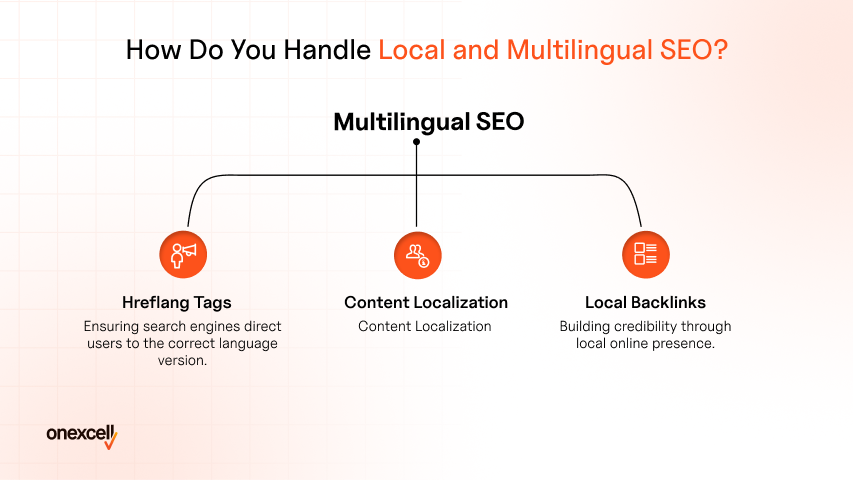
How Do You Handle Local and Multilingual SEO?
Handle multilingual SEO with a subdomain or subdirectory structure plus hreflang tags. A single English site does not rank well in Arabic-language markets across the Gulf. There are 3 actions per target market:
- Localise content fully, since tone, examples, and references must read as native.
- Use hreflang tags to signal the correct page version per market.
- Build backlinks from local financial directories, news sites, and industry resources.
Pro tip. If you plan to invest in SEO, start it on day one of the website plan, not after launch. The brokers who rank in competitive Gulf markets started SEO before they launched.
What Are the Most Common Forex Broker Website Mistakes?
The most common forex broker website mistake is copying large brokers without understanding why their sections exist. There are 7 recurring mistakes that cost brokers traffic and conversions, listed below.
| Mistake | Why it costs the broker |
| Copying big brokers blindly | Their sections exist for historical or regional reasons that may not apply. |
| Generic headlines | Lines such as ‘Trade with confidence’ read as noise and convert no one. |
| Wrong numbers in content | Incorrect spreads, leverage, or asset counts damage trust and raise compliance flags. |
| No mobile optimisation | Most forex traffic is mobile, so a broken mobile layout loses most visitors. |
| Launching with thin content | Placeholder or missing sections start the Forex SEO journey behind. |
| Ignoring page speed | A 1-second delay in load time reduces conversions by up to 7%, per Akamai research. |
| No clear conversion path | If a visitor has to think about the next step, the visitor leaves. |
Frequently Asked Questions About Building a Forex Broker Website
How Much Does It Cost to Build a Forex Broker Website?
A forex broker website starts at £2,500, with the final cost set by customisation on request. The starting price covers a professional, fast, mobile-first website with standard third-party integrations. Extra languages, custom landing pages, copy-trading widgets, and advanced design raise the figure based on scope.
How Long Does It Take to Build a Forex Broker Website?
A forex broker website takes 6 to 10 weeks to build with professional design and standard integrations. A custom build with several languages, multiple landing pages, and advanced tools takes 3 to 5 months. Add time for compliance review of content and legal pages.
Which Technology Is Best for a Forex Broker Website?
WordPress is best for most forex broker websites, due to fast launch and easy content editing. A PHP framework suits brokers wanting custom features, and React suits brokers with a developer team who need maximum performance. The website is a promotional tool, so execution quality matters more than the technology.
Do You Integrate MT4 or MT5 Into the Website?
No, you do not integrate MT4 or MT5 into the website. The trading platforms run on their own infrastructure. The website connects to APIs for registration forms, live rates, an economic calendar, copy trading, Trading Central, and calculators, then links traders to the platform to trade.
Which Integrations Does a Forex Broker Website Need?
A forex broker website needs 5 core integrations: registration forms connected to the CRM, live rates, an economic calendar, calculators, and a copy-trading or social-trading widget. A live chat tool is the common sixth addition. These tools improve the trader experience and lift conversions.
When Should You Start SEO for a Forex Broker Website?
Start SEO on day one of the website plan, before any page is designed. Define target keywords, site structure, and a content plan first, and launch with every section live. SEO built in from the start outperforms SEO added after launch, and forex rankings take 3 to 6 months to appear.
Final Word on Building a Forex Broker Website From Scratch
Building a forex broker website from scratch follows the same 7 steps every strong broker build uses: market and content planning, domain and hosting, technology choice, UI/UX design, third-party integrations, landing pages, and Forex SEO. A forex broker website is a conversion engine, and each step protects the path from search traffic to a registered, funded trader.
There are 7 decisions that set the result, made in order:
- Decide the business model, regulatory setup, and target market before any website work.
- Choose the domain, hosting, and technology based on speed and team strength.
- Design every section with a purpose, building trust and guiding one action.
- Write content after the structure is set, in the language of the target country.
- Integrate only the tools that add value, starting with the registration forms.
- Start Forex SEO on day one and treat it as infrastructure.
- Launch with complete content, fast load times, and a clear conversion path on every page.
Traders judge a forex broker’s website in seconds. Brokers who build it right from the start spend less time and money fixing it later and more time growing a funded client base.