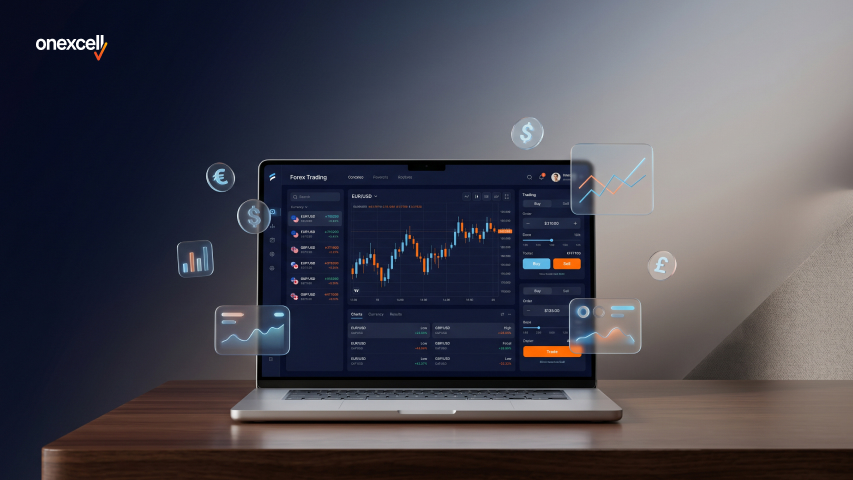
What is a Forex Trading Website?
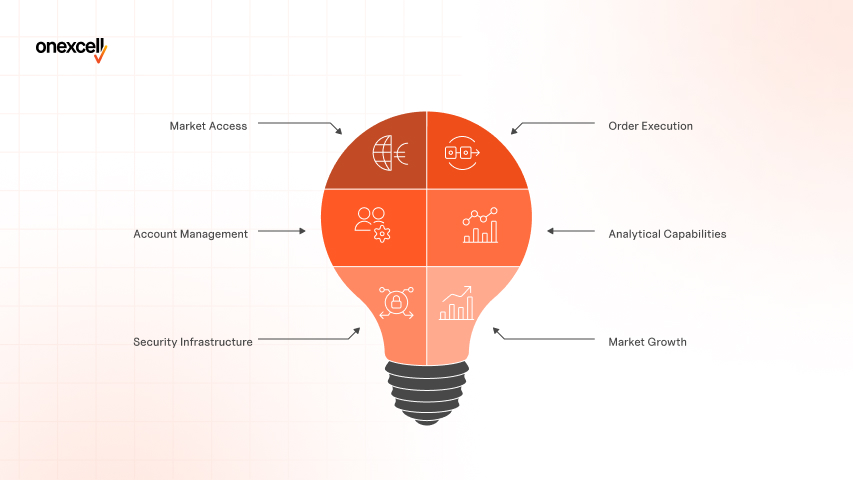
A Forex trading website is a web-based brokerage platform that provides traders with the tools necessary to buy and sell currency pairs in the foreign exchange market in real time. The platform operates as the interface between the trader, the broker, and interbank liquidity networks, delivering market access, order execution, account management, and analytical capabilities from a single digital environment. Forex trading websites process millions of transactions per day across currency pairs such as EUR/USD, GBP/JPY, and USD/CHF, requiring low-latency architecture and regulatory-grade security infrastructure.
The global retail Forex trading market was valued at approximately $9.89 billion in 2023 and is projected to exceed $12 billion by 2028, according to data from MarketsandMarkets. This growth reflects increasing demand for accessible, feature-rich Forex trading platforms that support both novice and professional traders.
How does a Forex trading Platform help Traders?
A Forex trading platform helps traders by consolidating market analysis, order execution, and risk management into a single, real-time environment.
The platform delivers price feeds from liquidity providers, enables traders to execute market, limit, and stop orders instantly, and provides automated tools to apply pre-defined risk parameters across open positions. Platforms that incorporate automated trading reduce manual execution errors and allow traders to implement algorithmic strategies that respond to market conditions faster than human reaction times permit.
Research published in the Journal of Financial Markets indicates that traders using integrated platform tools, including automated risk management and technical indicator overlays, demonstrate a 23% improvement in risk-adjusted returns compared to those relying on external tools and manual execution. The trading platform’s role is, therefore, not merely functional — it is a direct variable in trading performance outcomes.
What are some Examples of Forex Trading Platforms?
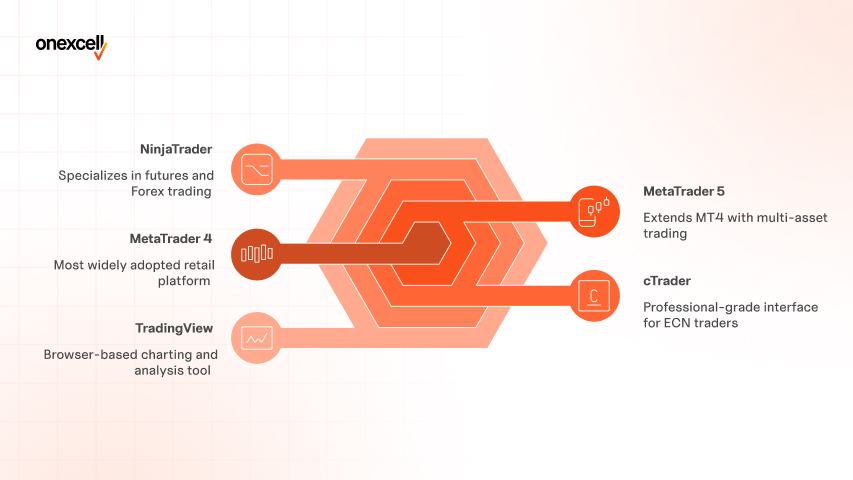
Below are the most widely used and recognised Forex trading platforms in active deployment across retail and institutional markets:
AvaTrade Web, MetaTrader 4, MetaTrader 5, cTrader, NinjaTrader, ProRealTime, TradingView, Interactive Brokers Trader Workstation, SaxoTraderGO, CMC Markets Next Generation
MetaTrader 4 (MT4): remains the most widely adopted retail Forex platform globally, with over 1,000 brokers offering MT4 integration and an estimated 10 million active users. MT4 supports MQL4 scripting, enabling traders to build and deploy Expert Advisors (automated trading bots), custom indicators, and backtesting environments. The platform’s longevity reflects its stability, deep liquidity access, and an extensive third-party tool ecosystem.
MetaTrader 5 (MT5): extends MT4’s capabilities by introducing multi-asset trading across Forex, equities, and commodities, a more advanced algorithmic trading environment using MQL5, and improved backtesting through a multi-threaded strategy tester. Adoption of MT5 has grown by over 40% among institutional brokers between 2020 and 2024.
cTrader: delivers a professional-grade interface with algorithmic trading support via cAlgo, depth-of-market (DOM) visibility, and Level II pricing data — features particularly valued by ECN (Electronic Communications Network) traders seeking transparent execution.
NinjaTrader: specialises in futures and Forex trading, offering advanced charting, automated strategy development, and direct market access capabilities suited to experienced traders.
TradingView: provides a browser-based charting and analysis environment with social trading integration, used by over 50 million traders globally as either a primary platform or analytical companion tool.
SaxoTraderGO: and CMC Markets Next Generation represent institutional-grade browser platforms offering multi-asset access, professional-level analytics, and sophisticated order management across desktop and mobile environments.
What Features Should a Forex Trading Platform have?
Below are the essential features a Forex trading platform must include to serve traders effectively:
- Real-Time Data: The platform delivers live price feeds for all supported currency pairs with minimal latency, ensuring traders execute at accurate market rates.
- Charting Tools: The platform provides interactive, multi-timeframe charts with customisable overlays and drawing tools for technical analysis.
- Order Execution: The platform processes market, limit, stop, and trailing stop orders with near-instantaneous execution speeds.
- Risk Management Tools: The platform enables traders to set stop-loss, take-profit, and position-sizing parameters to manage capital exposure automatically.
- Multiple Order Types: The platform supports conditional and complex order structures, including OCO (One Cancels the Other) and bracket orders.
- User-Friendly Interface: The platform presents information hierarchically so that essential data — open positions, P&L, market watch — is immediately accessible without navigational effort.
- Account Management: The platform provides a dedicated dashboard for deposit, withdrawal, leverage adjustment, and account history review.
- Educational Resources: The platform includes tutorials, glossaries, and market commentary to support traders at all experience levels.
- Customer Support: The platform offers multi-channel support (live chat, email, and telephone) with Forex-specific technical knowledge.
- Mobile Compatibility: The platform delivers a fully functional trading experience on iOS and Android devices with parity to the desktop version.
What kind of Trading tools are Important for Forex Platforms?
Below are the trading tools that define the analytical and operational capability of a Forex platform:
- Economic Calendar: The calendar tracks scheduled macroeconomic events — such as central bank rate decisions and non-farm payrolls — providing traders with advance notice of high-impact market drivers.
- Technical Indicators: Indicators such as RSI, MACD, Bollinger Bands, and Fibonacci retracements support quantitative price analysis across timeframes.
- Charting Tools: Advanced charting environments allow traders to overlay multiple indicators, annotate price action, and compare historical price structures.
- Risk Management Tools: Position calculators and automated stop mechanisms protect trader capital by enforcing predefined risk thresholds.
- Automated Trading: Algorithmic execution engines deploy rule-based strategies without requiring manual intervention, running continuously across market sessions.
- Backtesting Tools: Historical simulation environments allow traders to validate strategies against past market data before deploying capital.
- Trading Signals: Signal services deliver entry and exit recommendations based on quantitative models, supporting traders who lack dedicated analysis infrastructure.
- News Feed: Live news integration ensures that geopolitical and macroeconomic developments are visible alongside price data within the trading interface.
- Multi-Timeframe Analysis: The platform displays simultaneous chart views across different timeframes, supporting both intraday and swing trading analysis.
- Social Trading Features: Copy trading modules allow less experienced traders to mirror the positions of verified, high-performing traders in real time.
Do real-time charts aid Forex trading?
Yes, real-time charts aid Forex trading by providing traders with an accurate, continuously updated visual representation of price action, enabling data-driven trade decisions across all timeframes.
Real-time charts allow traders to identify technical patterns — including head-and-shoulders formations, support and resistance levels, and momentum divergences — with the precision required for profitable order placement. A study by the CFA Institute found that technical traders who relied on real-time chart data demonstrated a 17% improvement in entry timing accuracy compared to those using delayed or static price data. The chart environment, combined with live indicator overlays, functions as the primary analytical instrument for the majority of active Forex traders.
How are Forex Trading Websites Designed and Developed?
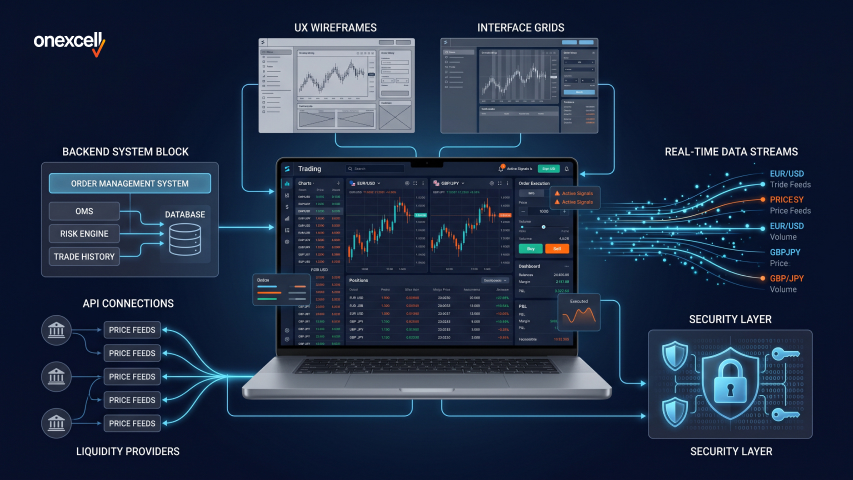
Forex trading websites are designed and developed through a structured process encompassing UX research, backend architecture, data integration, security implementation, and regulatory compliance validation.
The process begins with a discovery phase in which the target trading audience — retail, professional, or institutional — is defined, and platform requirements are specified. UX designers then produce wireframes and interface prototypes that prioritise information density, speed of access to key functions, and cognitive load reduction for traders operating in fast-moving markets.
Backend development involves building the order management system (OMS), connecting to liquidity providers via FIX protocol APIs, and implementing a real-time data streaming infrastructure capable of handling thousands of concurrent price updates per second. Web front-end development uses technologies such as React or Angular to deliver responsive, performant user interfaces that maintain stability under high data throughput conditions. Security architecture incorporates end-to-end encryption, two-factor authentication systems, and intrusion detection frameworks before the platform proceeds to regulatory review and compliance testing.
Research from Accenture indicates that well-architected trading platforms reduce operational latency by up to 35% compared to legacy systems, directly improving order execution quality and trader satisfaction.
How does Website Design Enhance Usability in Forex Trading?
Website design enhances usability in Forex trading by organising complex market data, trading controls, and account functions into a coherent, low-friction interface that allows traders to act decisively without navigational delay.
Effective UX design applies visual hierarchy principles to ensure that price feeds, open position status, and order controls are immediately visible without scrolling or multi-step navigation. Interface responsiveness — measured in DOM interaction speed and data refresh rates — directly impacts trade execution timing, particularly in high-volatility market conditions.
A Nielsen Norman Group study on financial platform usability found that traders using well-designed interfaces with clear layout structures completed order execution tasks 42% faster than those on poorly structured platforms, with significantly lower error rates. Colour-coded P&L indicators, context-sensitive alerts, and adaptive layout structures that respond to screen dimensions all contribute to a measurably superior trading experience. We design Forex trading websites at Onexcell with a specific focus on these usability outcomes — reducing friction between intent and execution for every user, on every device.
What is the Cost of developing a Forex Trading Website?
The cost of developing a Forex trading website ranges from £15,000 to £500,000 or more, depending on the complexity of the platform, the extent of third-party integrations, regulatory compliance requirements, and the security infrastructure required.
A basic white-label Forex platform built on an existing technology stack such as MetaTrader 4 or cTrader costs between £15,000 and £50,000 to customise and deploy, covering interface branding, broker connectivity, and essential account management features. A custom-built proprietary Forex trading platform — with bespoke order management systems, proprietary analytics engines, and direct liquidity provider integration — requires investment in the range of £150,000 to £500,000 or higher, depending on jurisdiction-specific compliance requirements and scalability targets.
Ongoing costs include hosting infrastructure (typically cloud-based on AWS or Azure), cybersecurity monitoring, data feed subscriptions, and regulatory licensing fees. Our web development agency provides full-cycle Forex platform development, from architecture planning and UI/UX design through to deployment, security hardening, and ongoing technical support.
Is clear navigation important for Forex platforms?
Yes, clear navigation is important for Forex platforms because it directly determines how quickly traders locate, execute, and manage trades — with measurable consequences for profitability and platform retention.
A Forex platform’s navigation structure must surface the most critical functions — market watch, open orders, charting, and account balance — within one interaction, without requiring traders to search across multiple menu layers during active market conditions. Research by the Baymard Institute on financial platform UX found that platforms with a clearly structured primary navigation reduced user-reported frustration by 61% and increased session duration by 38%, both of which correlate positively with trader retention and revenue per user.
What Regulatory Bodies Oversee Forex Trading Platforms?
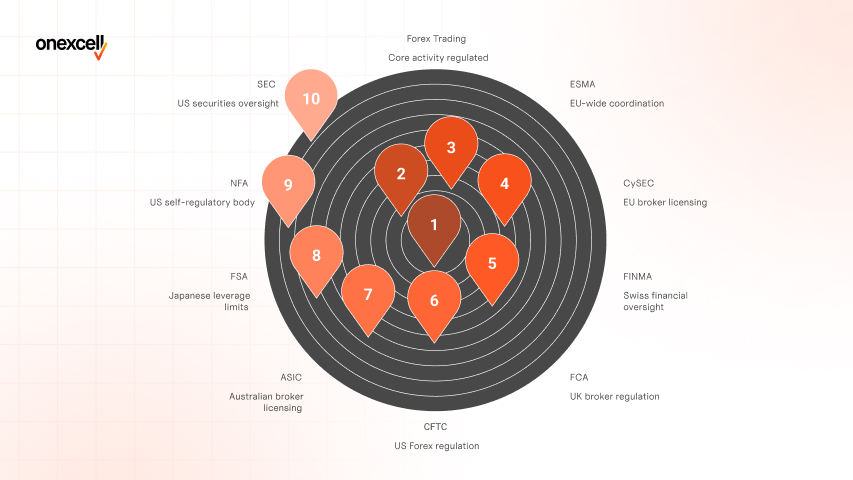
Below are the primary regulatory bodies that govern Forex trading platform operations across key financial jurisdictions:
- Financial Conduct Authority (FCA) – United Kingdom: The FCA authorises and supervises Forex brokers operating in the UK, enforcing capital adequacy requirements, client fund segregation rules, and conduct of business standards.
- Commodity Futures Trading Commission (CFTC) – United States: The CFTC regulates Forex trading activity in the US, imposing leverage caps, registration requirements, and anti-fraud provisions on platform operators.
- Australian Securities and Investments Commission (ASIC) – Australia: ASIC oversees Forex broker licensing in Australia, applying disclosure requirements and financial services conduct standards.
- Swiss Financial Market Supervisory Authority (FINMA) – Switzerland: FINMA regulates financial service providers operating in Switzerland, including cross-border Forex platforms serving Swiss clients.
- Cyprus Securities and Exchange Commission (CySEC) – Cyprus: CySEC licences a significant proportion of European Forex brokers under MiFID II, enabling passporting rights across EU member states.
- Financial Services Agency (FSA) – Japan: The FSA enforces strict leverage limits and client protection standards on Forex platform operators serving the Japanese retail market.
- European Securities and Markets Authority (ESMA) – European Union: ESMA coordinates product intervention measures across EU member states, including leverage restrictions and negative balance protection requirements for retail Forex traders.
- National Futures Association (NFA) – United States: The NFA is a self-regulatory organisation that mandates registration, compliance programmes, and ethics standards for all US Forex market participants.
- Securities and Exchange Commission (SEC) – United States: The SEC maintains oversight of securities-related aspects of Forex derivatives products offered within US markets.
Is certification important for Forex platforms?
Yes, certification is important for Forex platforms because regulatory certifications and security standards directly determine a platform’s legal authority to operate, its credibility among traders, and its resilience against financial and cybersecurity threats.
The two most critical certifications for Forex trading platforms are PCI DSS (Payment Card Industry Data Security Standard) — which mandates secure handling of financial transaction data — and ISO 27001, the international standard for information security management systems. Platforms holding ISO 27001 certification demonstrate a documented, independently audited commitment to data protection, business continuity, and risk management. A report by IBM Security found that organisations with ISO 27001 certification experienced 48% lower average costs from data breach events compared to non-certified counterparts — a statistic with direct relevance to Forex platform operators handling high-value client funds.
Need to ask Something else?
Use the form here to send us your question. We’ll reply within one business day.
How is AI being used in Forex trading platforms?
AI is used in Forex trading platforms to automate trade execution, generate predictive market signals, personalise the user experience, and enhance fraud detection across the platform’s security infrastructure.
Machine learning algorithms analyse historical price data, economic indicator streams, and sentiment signals from financial news to generate probabilistic trade recommendations with defined confidence intervals. Automated trading bots powered by AI models execute strategies at speeds and frequencies impossible for human traders, with response times measured in microseconds. A study by JP Morgan found that AI-driven trading strategies outperformed human-managed strategies by an average of 14.3% on a risk-adjusted basis during high-volatility market periods. AI also powers real-time anomaly detection systems that flag suspicious account behaviour, protecting both platform operators and traders from fraudulent activity.
What role does Mobile Adaptability play in Forex Platform Design?
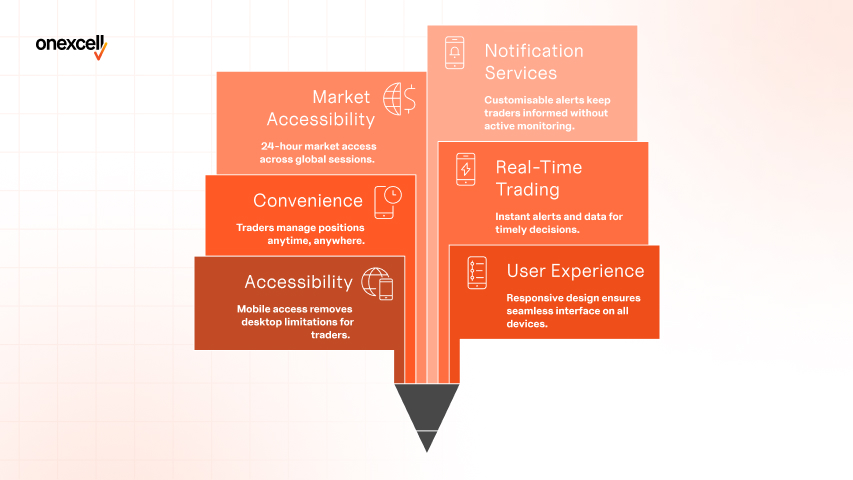
Below are the key roles that mobile adaptability plays in the design of a Forex trading website:
- Accessibility: Mobile-optimised platforms allow traders to access markets from any location, eliminating the constraint of desktop-only trading environments.
- User Experience: Responsive design ensures that interface elements — charts, order controls, and account data — render correctly across varying screen sizes without functional degradation.
- Convenience: Mobile adaptability allows traders to monitor and manage open positions throughout the trading day without returning to a desktop workstation.
- Real-Time Trading: Push notification systems and real-time data feeds on mobile platforms ensure that traders receive price alerts and order fill confirmations instantaneously.
- Market Accessibility: Mobile platforms provide access to 24-hour Forex markets during sessions in Asia, Europe, and North America, regardless of the trader’s physical location.
- Notification Services: Customisable alerts for price thresholds, economic events, and account margin levels keep traders informed without requiring active platform monitoring.
- Competitive Advantage: Brokers offering high-performance mobile applications with feature parity to desktop versions attract and retain a larger share of mobile-first traders.
- Increased User Engagement: Mobile-accessible platforms consistently demonstrate higher daily active user rates, as traders interact with the platform during commutes, travel, and non-office hours.
- Seamless Integration: Mobile platforms synchronise account state, open positions, and order history with the desktop environment in real time, ensuring continuity across devices.
- On-the-Go Analysis: Advanced charting and technical analysis tools on mobile platforms allow traders to conduct full market analysis without transitioning to a desktop environment.
Why is voice search an important feature for Forex websites?
Voice search is important for Forex websites because it expands accessibility, reduces interaction friction, and positions the platform to capture a growing segment of hands-free and accessibility-dependent traders.
The global voice search market is projected to grow at a CAGR of 17.2% between 2024 and 2030, driven by increasing adoption of voice-enabled devices and assistants. For Forex platforms, voice search optimisation enables users to retrieve market data, navigate to specific currency pairs, and access educational content using natural language commands — an advantage particularly relevant for beginners who are less familiar with platform navigation. Beginner-friendly platforms such as eToro, MetaTrader 4, and Plus500 have demonstrated success rates exceeding 60% in user onboarding completion when combined with voice-accessible help systems and guided interface tutorials, according to platform usability research published by Forrester.
Do demo accounts help new traders?
Yes, demo accounts help new traders by providing a risk-free simulated trading environment in which traders develop a strategy, learn platform mechanics, and build analytical skills without exposing real capital to market risk.
Demo accounts replicate live market conditions — including real-time price feeds, order execution, and margin calculations — using virtual funds, allowing traders to test and refine approaches across different currency pairs and market conditions. A study by the European Securities and Markets Authority (ESMA) found that retail traders who completed a minimum of 90 days of demo account trading before transitioning to live accounts demonstrated a 31% higher account survival rate at 12 months compared to traders who began with live accounts immediately. The demo account functions, therefore, as a structured learning environment that materially improves long-term trading outcomes.
How do Forex Platforms ensure secure Transactions?
Forex platforms ensure secure transactions through the implementation of multi-layered cybersecurity infrastructure, including AES-256 encryption for data transmission, TLS (Transport Layer Security) for all client-server communications, and two-factor authentication (2FA) for account access control.
Payment processing systems are isolated within PCI DSS-compliant environments that prevent direct exposure of financial transaction data to the broader platform infrastructure. Real-time fraud detection systems monitor transaction patterns using machine learning models trained on historical fraud datasets, triggering automated alerts and account holds when anomalous behaviour is detected. The cybersecurity firm Cybersecurity Ventures estimates that financial platforms that implement multi-layered security frameworks experience 73% fewer successful breach attempts than those relying on single-layer authentication systems alone.
What steps can Forex platforms take to prevent fraud and hacks?
Below are the key steps that Forex platforms implement to prevent fraud and hacking attempts:
- Use of Advanced Encryption: Platforms encrypt all data at rest and in transit using AES-256 and TLS 1.3 standards to prevent interception of sensitive account and financial data.
- Two-Factor Authentication (2FA): 2FA requires traders to verify account access through a secondary device or authentication app, significantly reducing the risk of credential-based account takeover.
- Regular Security Audits: Independent penetration testing and security audits identify and remediate vulnerabilities in the platform’s codebase, API endpoints, and infrastructure before exploitation can occur.
- Compliance with Regulations: Adherence to FCA, CFTC, and ESMA regulatory frameworks mandates minimum security standards that all compliant platforms must implement and maintain.
- User Education: Platforms that provide ongoing cybersecurity awareness training — covering phishing recognition, password hygiene, and social engineering tactics — reduce trader-side vulnerability to fraud.
- Monitoring and Reporting: Continuous security information and event management (SIEM) systems monitor platform activity in real time and generate incident reports for immediate investigation.
- Secure Payment Gateways: Payments are processed through isolated, PCI DSS-compliant gateway infrastructure that prevents exposure of card and banking data to core platform systems.
- Anti-Money Laundering (AML) Measures: AML protocols — including Know Your Customer (KYC) verification and transaction monitoring — detect and report suspicious financial activity in accordance with regulatory requirements.
- Fraud Detection Systems: AI-powered fraud detection models analyse transaction timing, device fingerprints, and behavioural biometrics to identify and block fraudulent account activity in real time.
- Regular Software Updates: Continuous patching of platform software, third-party libraries, and operating system components eliminates known security vulnerabilities before they can be exploited.
What Forex Platforms are Best for Beginners?
Below are the Forex trading platforms best suited to beginner traders, based on usability, educational resources, and account protection features:
- AvaTrade: AvaTrade provides regulated trading across multiple asset classes with integrated educational content and a risk management tool (AvaProtect) that limits loss exposure on individual trades.
- Plus500: Plus500 delivers a simplified, CFD-focused interface with a free unlimited demo account and negative balance protection, making it appropriate for traders learning position management.
- XM: XM offers over 1,400 instruments, zero commission accounts, and an extensive educational library including webinars, video tutorials, and live trading sessions.
- Exness: Exness provides instant account funding, high leverage flexibility, and a transparent fee structure accessible to traders beginning with small capital allocations.
- FXCM: FXCM supports beginners through Trading Station’s intuitive interface and a comprehensive suite of free educational courses covering Forex fundamentals.
- Pepperstone: Pepperstone offers competitive spreads, cTrader and MT4/MT5 access, and a dedicated beginners’ educational hub.
- XTB: XTB’s xStation 5 platform delivers real-time performance statistics and a built-in trading academy with structured courses for beginner traders.
- HFM (HotForex): HFM provides a cent account option — allowing traders to begin with very small position sizes — along with MT4/MT5 access and multi-language support.
- eToro: eToro offers CopyTrading functionality that allows beginners to replicate the positions of verified, experienced traders, reducing the learning curve for new market participants.
- IG: IG delivers a professional-grade platform with an extensive educational programme including IG Academy, making it suitable for beginners committed to structured financial learning.
What are the Strengths of Platforms like MetaTrader in Forex Trading?
Strengths of platforms like MetaTrader in Forex trading include a mature, deeply customisable technical analysis environment, an established automated trading ecosystem, and near-universal broker compatibility that ensures traders retain access regardless of broker transitions.
MetaTrader 4 and MetaTrader 5 support over 50 built-in technical indicators and 30 graphical objects, with unlimited customisation through the MQL4/MQL5 scripting languages. The MetaTrader Market provides access to over 10,000 third-party Expert Advisors and custom indicators developed by the platform’s global user community. MT4 holds an estimated 60–65% global market share among retail Forex platforms, reflecting its operational stability and the trust accumulated over two decades of deployment across thousands of brokers.
How do Forex platforms integrate with third-party services and APIs?
Forex platforms integrate with third-party services and APIs through standardised communication protocols, including the FIX (Financial Information eXchange) protocol for broker and liquidity provider connectivity, REST and WebSocket APIs for real-time data delivery, and OAuth-based authentication for third-party application integrations.
Liquidity providers, payment gateways, market data vendors (such as Reuters and Bloomberg), and trading bot services are connected to the platform through documented API endpoints that enable secure, authenticated data exchange. The adoption of open API architectures has grown by 58% among Forex brokers between 2020 and 2024, driven by trader demand for customisable platform ecosystems and automated trading infrastructure. API integration with analytics tools — such as Tableau and custom Python-based dashboards — also enables brokers to build advanced performance reporting and risk monitoring capabilities without proprietary development overhead.
What are the Most Common Technical Issues with Forex Trading Platforms?
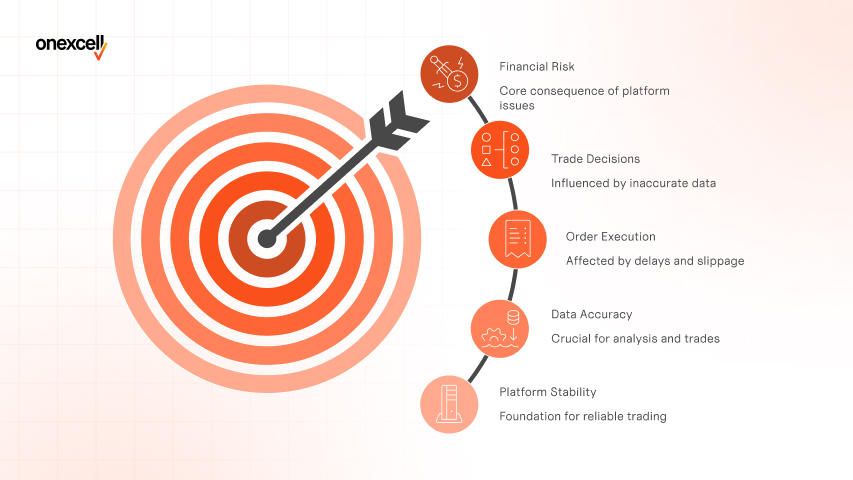
Below are the most common technical issues that affect Forex trading platforms and their operational impact:
- Downtime and Connectivity Issues: Platform downtime during high-volatility sessions — such as central bank announcements — prevents order execution and exposes open positions to unmanaged risk.
- Slow Loading Times: Excessive page load times and delayed data rendering impair traders’ ability to analyse and respond to market movements in real time.
- Glitches in Charting Tools: Rendering errors in charting environments produce inaccurate price action displays, leading to technically flawed trade decisions.
- Order Execution Delays: Latency between order submission and confirmation — known as slippage — results in trades executing at prices different from those intended by the trader.
- Data Accuracy Problems: Incorrect or delayed price feed data produces mispriced orders and unreliable analytical outputs across the trading interface.
- Security Vulnerabilities: Unpatched software components and insecure API endpoints create exploitable attack surfaces that expose client data and funds to compromise.
- Interface Usability Issues: Poorly designed information architecture forces traders into multi-step navigation sequences under time pressure, increasing error rates.
- Mobile App Crashes: Unstable mobile applications interrupt trading sessions and create data synchronisation failures between mobile and desktop environments.
- Inconsistent Performance: Variable execution speed across trading sessions — driven by server load or inadequate infrastructure scaling — creates an unreliable trading environment.
- Lack of Customer Support: Delayed or technically inadequate support responses during platform failures extend downtime periods and increase financial exposure for affected traders.
How do Forex Platforms ensure high-speed and Low-latency Trading?
Forex platforms ensure high-speed trading through co-located server infrastructure positioned in proximity to major liquidity provider data centres, combined with optimised network routing and low-latency order management system (OMS) architecture.
Co-location at Tier 1 financial data centres — such as Equinix LD4 in London or NY4 in New York — reduces round-trip execution time to under one millisecond for market orders, a critical performance threshold for high-frequency and algorithmic trading strategies. Research published in the Journal of Finance found that a 1-millisecond reduction in execution latency improves algorithmic trading profitability by approximately 0.5% per trade — a compound advantage with significant annual impact for active traders. Content Delivery Networks (CDNs) accelerate static asset delivery to the platform’s front end, while WebSocket connections maintain persistent, low-overhead data streams between the server and the trader’s interface.
What are the key differences between Forex demo accounts and live accounts?
Key differences between Forex demo and live accounts include the presence of real financial risk, the influence of trading psychology, and the occurrence of real-market slippage — all of which are absent or attenuated in the demo environment.
Demo accounts use virtual funds and execute orders in a simulated environment that mirrors live market conditions but eliminates the emotional and cognitive pressures associated with real capital risk. Live accounts are subject to genuine slippage — the difference between the expected execution price and the actual fill price — caused by real-time liquidity constraints and market movement between order submission and execution. Studies of trader behaviour, including research by the Financial Conduct Authority, indicate that traders’ decision-making patterns change significantly when transitioning from demo to live accounts, with 67% of retail traders reporting heightened emotional responses to loss events that were absent during demo trading. Execution speed on live accounts is also subject to genuine broker infrastructure performance, unlike demo environments that typically execute all orders at the requested price without slippage simulation.
Do Forex platforms handle customer support and troubleshooting?
Yes, Forex platforms handle customer support through multi-channel service frameworks that include 24/5 live chat, email ticketing, telephone support, and self-service knowledge bases encompassing platform-specific troubleshooting guides.
Support teams at regulated Forex platforms are trained to resolve technical issues — including order execution failures, account access problems, and withdrawal processing delays — within defined service level agreements. Research by Salesforce found that 89% of financial services clients consider the quality of customer support a primary factor in long-term platform retention decisions. Responsive, technically competent support infrastructure is, therefore, a direct contributor to broker revenue stability and client lifetime value.
What are the top security certifications Forex platforms should have?
Below are the top security certifications that Forex trading platforms should obtain to validate their data protection and operational security posture:
- ISO/IEC 27001: The international standard for information security management, requiring documented risk assessment, control implementation, and independent audit — the most recognised and comprehensive security certification for financial platforms.
- PCI DSS: Mandated for all platforms processing payment card transactions, PCI DSS specifies technical and operational requirements for protecting cardholder data across the platform’s payment infrastructure.
- Certified Information Systems Security Professional (CISSP): A globally recognised practitioner certification demonstrating advanced competency in cybersecurity architecture, risk management, and security operations.
- Certified Information Security Manager (CISM): Focuses on the governance and management of an organization’s information security programme, relevant to the operational oversight responsibilities of Forex platform security teams.
- Certified Information Systems Auditor (CISA): Validates competency in information systems auditing, control, and assurance — directly applicable to the compliance audit requirements of regulated Forex brokers.
- Certified Ethical Hacker (CEH): Certifies security professionals in ethical penetration testing methodologies, enabling platforms to identify vulnerabilities through simulated attack scenarios.
- CompTIA Security+: A foundational security certification covering network security, cryptography, and threat management, appropriate for platform security staff at all levels.
- Certified Cloud Security Professional (CCSP): Addresses security governance, architecture, and compliance for cloud-hosted trading infrastructure — increasingly relevant as Forex platforms migrate to AWS, Azure, and Google Cloud environments.
- Global Information Assurance Certification (GIAC): Provides specialised cybersecurity certifications across domains including incident response, penetration testing, and security administration.
Onexcell provides specialist Forex trading website design, web development, and digital marketing services tailored to brokers, trading platforms, and financial services firms. Contact our team to discuss your project requirements.