You drive organic traffic by building a strong Forex website first, earning visitors with useful content second, and converting those visitors into leads third. That order matters. Traffic without a solid site leaks away, and traffic that never converts is just a number. Get the 3 stages right and organic search becomes your cheapest, most reliable growth channel.
This guide is for any website owner who wants more visitors without paying for every click. The principles work for a shop, a service business, or a SaaS. They work with extra force for forex brokers and prop firms, where competition is fierce, so you will see broker examples throughout. The same logic even helps a trader judge which broker sites are trustworthy, because the signals that rank a site are the signals that earn trust.
Below, you get the full 3-stage process and 12 specific ways to put it to work. Onexcell builds and optimises websites at onexcell.co.uk, with deep experience in forex broker and prop firm websites across the Middle East, and this is the same process the team uses.
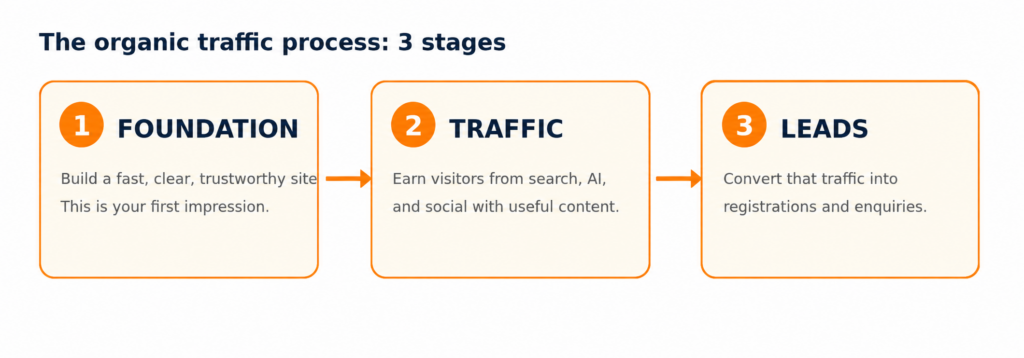
Stage 1. Foundation: Build the Impression
Before you chase traffic, build a site worth visiting. The foundation is your first impression: speed, clarity, and trust. Send visitors to a slow or confusing site and they leave, no matter how good your content is. A study by Deloitte Digital found that even a 0.1 second improvement in load time can lift conversions, which shows how much the basics move the needle.
1. Make Your Site Fast, Clear, and Easy to Trust
A fast, clear, trustworthy site is the floor everything else stands on. Visitors decide in seconds whether to stay. For a forex broker, that judgment is even harsher, because a trader is about to consider handing over money. There are 4 foundations that build a strong first impression:
- Load every page in under 2 seconds, especially on mobile, where most visitors arrive.
- Show trust signals clearly: who you are, contact details, and any credentials or regulations.
- Keep the design clean and uncluttered, so the visitor knows where to look.
- Make navigation obvious so anyone finds what they need in one or two clicks.
Pro tip. Test your speed with Google PageSpeed Insights and GTmetrix before you worry about content. A heavy homepage or oversized images, common on broker sites with live charts, will quietly cost you visitors no amount of SEO can win back.
2. Structure Content With a Clean Hierarchy
A clean structure makes a page easy to read for people and easy to understand for search engines. Look at any high-traffic site, and you will see the same thing: clear headings, short paragraphs, and a logical flow you can scan in seconds. This applies to your service and product pages as much as your blog.
There are 4 structure rules that hold across any site:
- Use one H1, then question-style H2S and H3S in a logical order.
- Keep paragraphs to 2 to 4 lines, so the page breathes.
- Lead each section with the point, then support it.
- Use tables and lists where they make a comparison or a process clearer.
3. Match Every Page to One Search Intent
Give each search intent its own page. Someone searching for a solution wants a different page from someone ready to buy. Trying to serve both on one page serves neither. Group related pages into hubs: one broad pillar page supported by focused guides, all interlinked, so search engines see that you cover the topic in depth.
A forex example makes it concrete. A visitor searching ‘best forex broker’ wants a commercial comparison. One searching ‘open a demo account‘ wants a transactional page. One searching ‘what is a pip’ wants a plain educational guide. Three intents, three pages. The same split applies to any business with research-stage and buying-stage visitors.
Stage 2. Traffic: Earn the Visitors
With the foundation set, you earn traffic by being the most useful, most consistent source for your audience. In 2026, that traffic comes from 3 places: classic search like Google and Bing, AI search like ChatGPT and Perplexity, and social platforms that now work as search engines. The content that wins all 3 is the same: clear, honest, and built around a real question.
Need to ask Something else?
Use the form here to send us your question. We’ll reply within one business day.
4. Write Intentional Content for One Audience
Serve one audience, in one market, and fix their problems through your writing. Most sites publish generic, fluffy content by copying high-traffic blogs and rewriting them. That builds nothing. Pick your reader and write to solve their real problems. For a broker, that might be beginner traders in the UAE. For a shop, it might be first-time buyers of one product line.
Stay on topic. If you serve one audience, do not chase off-topic pieces just because they get traffic somewhere else. Depth on one subject builds the authority that search engines and AI engines reward.
Pro tip. Build authority on a single topic before you widen out. Ten sharp articles that solve one audience’s problems will outperform fifty scattered posts. Depth signals expertise; breadth without depth signals a content farm.
5. Answer Fast, and Answer Directly
Put the answer first, then explain. When a visitor lands on your page, give them what they came for in the first 2 lines, then add the detail. Write H2s as the questions people actually ask, and answer right below each one. This serves the reader fast and gives AI engines a clean answer to quote, which is how you get cited in AI results.
The reading of all good books is like conversation with the finest people of the past centuries.
René Descartes
Good content is a conversation. Write like you are talking to one person who asked you one clear question, and answer them the way you would in person, without making them hunt for the point.
6. Treat Your Website Like a Social Channel
Keep your website active the way you keep a social account active. Some people post daily on Instagram but never touch their website, then wonder why it does not grow. A website rewards the same habit a feed does: keep publishing, keep optimizing, keep solving your audience’s questions. Every high-traffic site has this in common: they publish consistently, and no matter how big or small the blog, every post earns its place by solving a real problem.
7. Stop Stuffing Keywords, Match Intent Instead
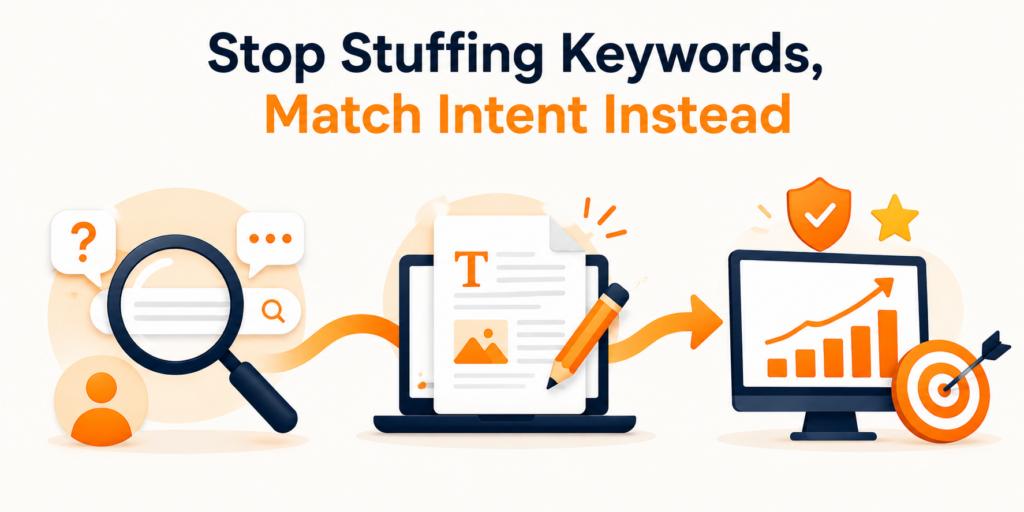
Do not overstuff keywords. Search engines and AI now understand intent. In 2026, Google and the AI engines read meaning, not just exact words. Write naturally for the reader, cover the topic properly, and the ranking follows. Use your main terms once or twice where they fit, then write for the human. Stuffing now signals low quality, and in trust-heavy niches like finance it gets you buried.
8. Refresh Old Content, Do Not Forget It
Once you publish a page, it is not finished. Update it as the facts change. Google rewards freshness, and HubSpot reported organic traffic lifts of up to 106% from updating old posts rather than writing new ones. Outdated facts also quietly destroy trust.
A forex example shows why this matters. The daily global forex turnover figure changes with each BIS Triennial Survey:
- April 2025: $9.6 trillion per day, up 28% from 2022.
- April 2022: $7.5 trillion per day.
- April 2019: $6.6 trillion per day.
If an article still says $7.5 trillion in 2026, it is out of date, and a sharp reader will notice. The same applies to any field with moving numbers: prices, statistics, screenshots, and broken links all age.
Pro tip. Keep a simple refresh calendar. Every quarter, open your top 10 pages, check every number against the current source, and update what has moved. This one habit protects both your rankings and your credibility.
9. Cover Trending Topics and Current Events
Publish on trending topics and current events, because they pull traffic fast. When something big happens in your field, people search for it immediately. A timely, useful article captures that wave. This is exactly what high-traffic sites do, and it works especially well for brokers, since the market hands you fresh news every single day.
Do it properly. Do not post a thin reaction. Elaborate, fit the topic to your audience, and write something genuinely useful, for example how a central bank decision affects the products your readers care about. Timely plus useful is what wins.
10. Repurpose Across Platforms, Including Instagram
Write unique value once, then repurpose it everywhere, because social platforms are now search engines too. People search inside Instagram, YouTube, TikTok, and Pinterest, not just Google. One strong guide can become a video, a carousel, and a set of posts, each one a new doorway to your site and a fresh source of leads.
There are several search surfaces worth repurposing for:
- Google and Bing for classic search.
- ChatGPT, Perplexity, and Gemini for AI search.
- YouTube for video search, the second-largest search engine.
- Instagram, TikTok, and Pinterest, where younger audiences search visually.
Then watch the data. Keep checking Google Analytics 4 and Google Search Console, see where your traffic and leads come from, and put more effort into the platforms that work.
Turn your website into a lead engine with Onexcell
Onexcell is a UK web design and development agency. The team builds fast, intentional, search-ready and AI-ready websites that move visitors from impression to traffic to leads. We work with businesses worldwide, with deep experience in forex broker and prop firm websites across the UAE, Qatar, Oman, and Kuwait.
Want an organic traffic plan for your site? Use the form at onexcell.co.uk to send your question. The team replies within one business day.
Stage 3. Leads: Convert the Traffic
Traffic only pays off when it converts. This final stage turns visitors into leads: enquiries, sign-ups, or registrations. Two things drive it: links that keep people moving through your site, and a clear path to one action on every page. Skip this stage, and you have a busy site with nothing to show for it.
11. Build Internal Links and Earn Real Backlinks
Internal links keep visitors reading; backlinks bring new visitors and trust. An internal link guides a reader from one useful page to the next, spreads ranking power, and signals which pages matter. Link a guide to a related tool, and a product page to a deeper explainer, so no useful page sits more than a click or two from another.
Backlinks are the other half. They bring referral traffic and act as a vote of confidence to search engines. The catch most people miss: do not just create a profile somewhere and leave it empty. Build the profile fully, then publish content on it wherever uploads are allowed, so the link sits next to something real.
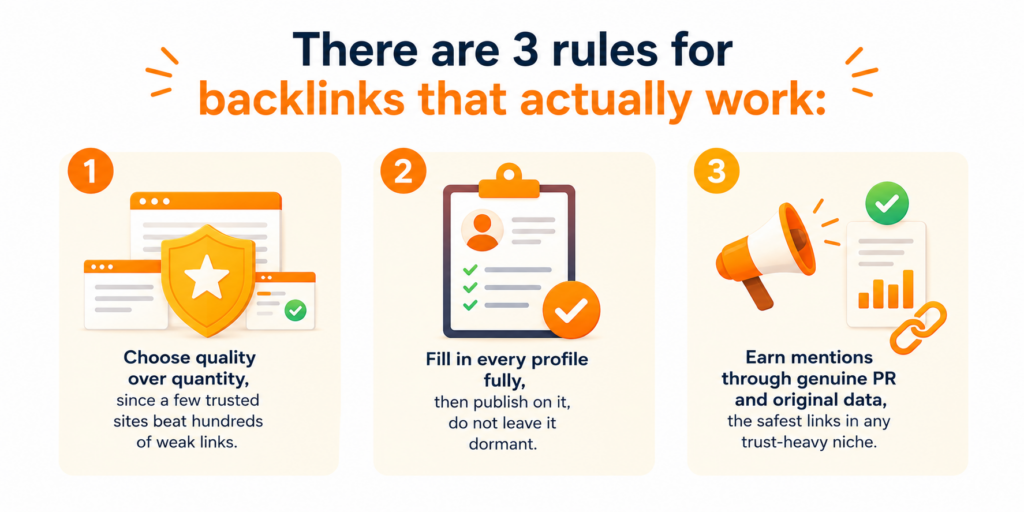
3 Rules for Backlinks Actually Work:
- Choose quality over quantity, since a few trusted sites beat hundreds of weak links.
- Fill in every profile fully, then publish on it, do not leave it dormant.
- Earn mentions through genuine PR and original data, the safest links in any trust-heavy niche.
Pro tip: Search your own brand name in Google right now. Whatever shows up, often a LinkedIn or Instagram profile, is usually the platform you are most active on. If your brand barely appears, it means competitors are simply showing up more often, on more platforms, than you. Visibility goes to whoever is most consistent across the places people look.
12. Guide Every Visitor Toward One Clear Action
Every page should point to one clear next step. Once a visitor is interested, do not make them guess what to do. Give each page a single, obvious action: register, enquire, download, or open an account. For a broker, that is usually opening a demo or live account. For a service business, it is a contact form or a call booking.
There are 4 ways to convert traffic into leads:
- Place one clear call to action where the visitor is ready to act, not buried at the bottom.
- Keep forms short, since every extra field loses people.
- Remove distractions on conversion pages, so nothing competes with the action.
- Show proof near the action: reviews, results, or credentials that reduce hesitation.
This is also where a trader judging a broker looks closest. A clean path, honest proof, and a simple registration signal a serious operator, which is the same impression that wins any audience.
What Stops Most Websites From Growing Organic Traffic?
The biggest blocker is skipping stages: chasing traffic on a weak site, or earning traffic that never converts. There are 7 mistakes that drain organic growth, listed below.
| Mistake | Why it Costs you |
| Weak foundation | A slow or confusing site loses visitors before content can work. |
| Generic, fluffy content | Rewriting big blogs builds no authority and helps no one. |
| Writing for everyone | Content with no single audience connects with no single reader. |
| Burying the answer | Here-and-there writing loses the reader and the AI citation. |
| Outdated facts | Old numbers break trust the moment a reader spots them. |
| Empty backlink profiles | Profiles created but never used waste the link and the effort. |
| No clear next step | Traffic with no obvious action converts into nothing. |
Frequently Asked Questions About Organic Traffic
1. How Long Does It Take to See Organic Traffic Results?
Organic traffic usually takes 3 to 12 months to grow meaningfully, depending on competition and your starting authority. Early AI visibility can appear within 2 to 8 weeks of publishing clear, answer-first content. Competitive niches like forex sit at the longer end, so consistency matters more than speed.
2. What Is the First Step to Driving Organic Traffic?
The first step is the foundation: a fast, clear, trustworthy website. Traffic sent to a weak site leaks away before it can convert. Fix speed, structure, and trust signals first, then earn traffic with useful content, then convert it into leads. That order is the whole process.
3. Does This Work for Any Website, or Only Forex?
It works for any website. The 3-stage process and the 12 ways apply to shops, service businesses, and SaaS alike. Forex brokers feel the pressure most because the niche is so competitive and trust-sensitive, which is why the examples lean that way, but the principles are universal.
4. Why Is My Content Getting Traffic but No Leads?
Traffic without leads usually means stage 3 is missing. The content attracts visitors but gives them no clear next step. Add one obvious call to action per page, keep forms short, remove distractions, and place proof near the action. Convert the interest you already earned.
5. Does Keyword Stuffing Still Work?
No. Search engines and AI engines now read intent, not repetition, and stuffing signals low quality. Use your main terms naturally a couple of times, cover the topic properly, and write for the reader. Clarity ranks; stuffing gets buried, especially in trust-heavy niches.
6. Can Social Platforms Really Drive Organic Traffic?
Yes. Instagram, YouTube, TikTok, and Pinterest now work as search engines, and people use them to find content. Repurpose one strong guide into a video, a carousel, and posts, each linking back to your site. This widens reach and brings leads from places Google cannot.
Final Word: Foundation First, Then Traffic, Then Leads
Driving organic traffic is not a bag of tricks. It is a process. Build a site worth visiting, earn visitors by being genuinely useful, and convert those visitors with a clear path to action. Do the 3 stages in order and each one makes the next one stronger.
Here are the 12 ways again, as a quick checklist:
- Make your site fast, clear, and easy to trust.
- Structure content with a clean hierarchy.
- Match every page to one search intent.
- Write intentional content for one audience.
- Answer fast, and answer directly.
- Treat your website like a social channel.
- Stop stuffing keywords; match intent instead.
- Refresh old content; do not forget it.
- Cover trending topics and current events.
- Repurpose across platforms, including Instagram.
- Build internal links and earn real backlinks.
- Guide every visitor toward one clear action.
Start with stage 1. A strong foundation makes every later effort pay off, whether you run a forex brokerage or any other business that lives or dies by who finds it online.